Piston rings Piston rings
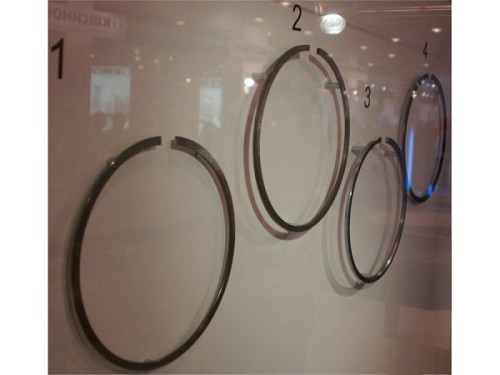
kfz-tech.de/PVe1
Upper piston rings
|
| 1 | Nitrided steel, chromium nitride PVD coating (Premium) |
| 2 | Ductile iron, chromium nitride PVD coating (high value) |
| 3 | Chrome silicon alloy steel, optimized plasma coating |
| 4 | Ductile iron, chrome ceramic coating |
These days they are probably always located at the upper end of the piston between the piston crown and the piston pin, two compression rings and one oil scraper ring, the former usually in one piece, the latter often
consisting of several parts. It was not always like this. E.g. there were more compression rings and also oil scraper rings and one of them at the bottom of the piston.
Of course, such a set for a two-stroke engine with pre-compression in the crankcase does not contain an oil scraper ring. Whenever there are slits in the course of the pistons, the piston rings are secured against twisting
with small pins, for example, so that the ends do not get caught in them.
Piston rings are usually made of special cast iron, but sometimes the top one is made of steel. The material must be resilient to ensure a certain contact pressure on the cylinder wall. In the case of the oil scraper ring, this is
even particularly important for its effectiveness, oil mainly return on the way from TDC to UT to the inside and to the oil sump.
If the spring effect decreases here, oil consumption may increase. In general, a certain amount of time was usually spent during the adjustment to determine the remaining amount of oil. As I said, wear and oil consumption
are irreconcilably opposed here. More recently, the aspect of friction and thus efficiency has even been added.
This is why the piston rings have become increasingly narrow. You can hardly notice that the outside can be slightly convex. Coatings such as chromium and molybdenum are also possible. Their springy effect makes them
difficult to handle in the workshop. If you overstretch cast iron ones even a little bit more than necessary, they can easily break.
There are pliers for this that make it easier to calibrate more precisely. Of course, the fact remains, they have at least to cross the fire land. After all, this and the other chambers between the piston rings are smaller in
diameter than, for example, the piston skirt below or the piston ring including the clearance between the piston ring ends. The grooves also deserve special attention during (dis)assembly.
They should have a certain height, precisely designed so that pressure can build up in them behind the piston rings, which helps when pressing against the cylinder wall. The underside then acts as a seal. If they are worn
out in height and therefore too big, a naturally undesirable rattling and pumping effect can occur. And of course everything behind the piston rings has to be clean.
The top ring has the hardest job. It is exposed to a higher temperature and, with the least amount of lubrication, is directly affected by the combustion pressure. This influences its choice of material. It's easier for the second
ring. As its name suggests, it is also more important for sealing than for the whereabouts of residual oil. The oil scraper ring does this, but always in coordination with the cylinder wall.
A lot has happened to it in the meantime, although experts with an overview claim that it is still mainly honed, instead of roughened with plasma spraying here. However, the latter method brings the better defined roughness,
which is often guaranteed from the very first engine run. With honed cylinders, a run-in phase for the friction partners is still necessary, depending on the roughness.
If the cylinder has to be reworked due to scoring or distortion, this is based on the pistons available as oversize. They usually are supplied with piston rings. After the cylinders have been machined, they can be assembled in
a mutually offset position with their butt joints.
However, it is also possible that pistons and rings are supplied separately, especially if there is more than one oversize. That comes from the tuner's traditional search for every gram of performance, i.e. total utilization of the
displacement limits. Then another excess can be interesting. However, a dimension for the clearance between the piston ring ends given by the piston manufacturer would be wrong.
Why? Because this depends in particular on the temperature during operation, which of course differs significantly in normal everyday use from that on the racetrack, possibly even with charging. A spreadsheet with different
clearances between the piston ring ends depending on the application is included.
No, you can't really adjust the clearance between the piston ring ends, because that would mean being able to reduce it as well. What remains is to be able to enlarge a piston ring with the smallest possible gap by grinding.
To do this, you maneuver it into the cylinder in such a way that the two joints cause as little damage as possible and align it as it would be at TDC.
Perhaps not so important here, but later when properly installed is the fact that piston rings can have a marked top. So, now the feeler gauge is used. Five hundredths, rounded up if necessary, are sufficient to determine the
clearance between the piston ring ends. There are special, not too expensive machines for grinding that guarantee a straight cut.
Of course, a ground surface must also be deburred. In the end over all edges with your finger is a good control. With newer, multi-part oil control rings, the process can be a little more complicated. When installing the piston
rings, the Mercedes star rule is sometimes deviated from and the joints are placed in such a way that none of the compression rings are on the pressure side.
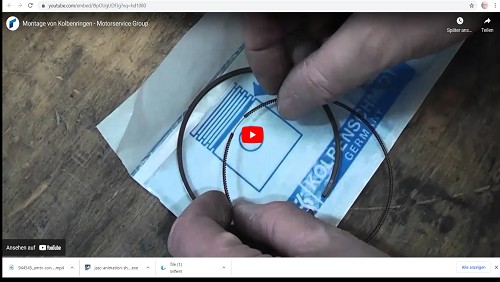
kfz-tech.de/YVe1
|