Driving dynamics 3 Driving dynamics 3
kfz-tech.de/PRa12
We've talked about the weight that's acting on the tire or wheel. Too much of it is disadvantageous for wheels on the outside of the curve and beneficial for wheels that are braking. Such a truck has a much
smaller contact area in relation to its weight, but brakes almost as well as a car.
However, the mass should also be well distributed over the axles, as we have seen with rear-engine vehicles. Often a lot of mass also compensates if the tire is not quite optimal on the road. Because actually he
should do that with the full contact area.
No, that is not always the case. Imagine a vehicle leaning more and more to the side when cornering. If the wheels were now rigidly connected to the body, they would only stick with their outer part of the tread.
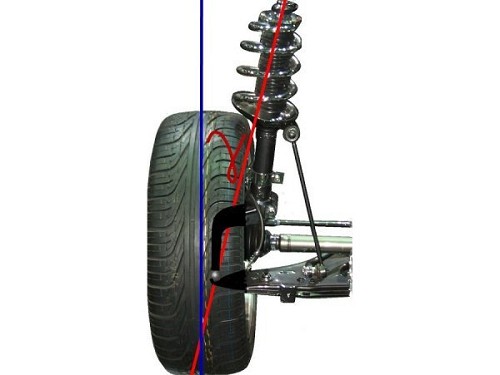
So that they stand on the road with their full width, the angle between the wheel and the body must change when the spring deflects. It is said that it must receive more negative camber so that it is as
perpendicular as possible to the surface of the road.
On the rear axle, suitable axle constructions ensure this, from the old days to a certain extent the rigid axle, more recently independent wheel suspensions, e.g. with shorter linkage at the top and longer at the
bottom. Of course, the relationship between the tilt angle and camber depends on the quality of the friction on the road.
At the front there is additional steering. Here the camber when driving straight ahead and normal load can be zero, but with the steered wheel on the outside of the curve it should be negative. The combination of
caster and spread helps here.
The caster indicates the inclination of the swivel axle from above to the rear, the spread from above to the inside. The latter must be greater than the caster at the wheel on the outside of the curve, while both add
up at the wheel on the inside of the curve. In this way, steered wheels also ensure as much contact with the road as possible.
Further there is the already mentioned braking and acceleration. The former should be avoided in the curve anyway if possible. Sometimes it is enough to decelerate to turn an oversteer into an understeer,
especially if the former was provoked by too much gas.
Now we have arrived at the movements around the transverse axle. Since both of the above lead to what we call 'nodding'. This can also sometimes be observed in occupants driving a relatively hard-suspended,
short-wheelbase car over a rough road.
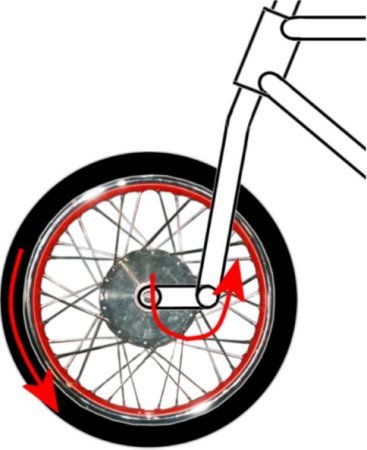
You can also do something constructively against nodding, as the picture above of a two-wheeler demonstrates. It doesn't dive as much at the front under braking because there's a twisting force on the small
trailing arm at the bottom of the fork in the direction of erecting. Something like this, albeit more complicated, is also possible with four-wheelers at the front and against diving too deep when accelerating at the
rear.
But no matter what the chassis does, it affects all possible positions of the tire, but the tire has to carry it out. And if the friction is too low, e.g. due to wetness or black ice, all these preparations are almost
pointless. Incidentally, all-wheel drive does not help when braking.
kfz-tech.de/YRa6
|