Body - Subframe Body - Subframe
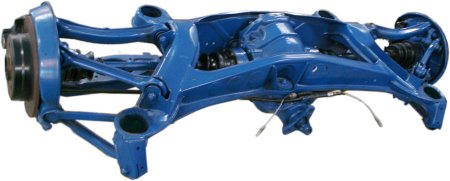
What is that, a subframe? In the geginning of car history we had ladder frames and rigid axles and the subframe was nestled between them after their dissolution.
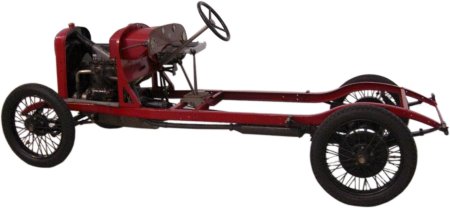
Here you can see that a subframe is not necessary for a rigid rear axle suspended from leaf springs. Also, the twisted-beam rear axle in the picture below needs as so-called semi-rigid axle no subframe. It is attached
to the outer longitudinal beams and is thus easily removable in case of repair.
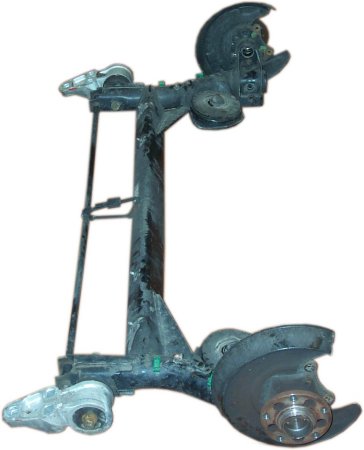
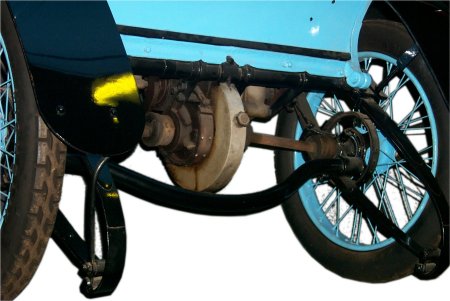
Even the first DeDion axle (patent 1893) connected the two wheels rigidly, but needed a bracket for the final drive. Is this cross brace in the chassis already a subframe? Independent wheel suspensions are launched
in the 1930s. The McPherson strut is not invented yet, so there are front wishbones below and above need support.
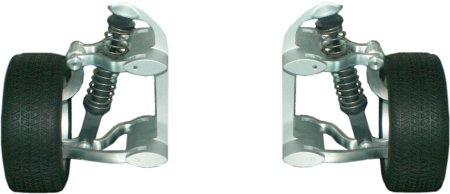
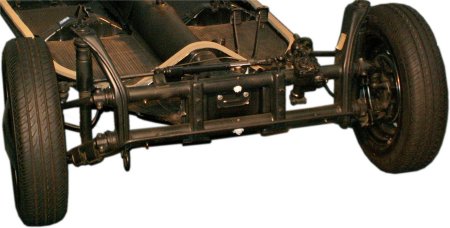
In this image of such a more modern suspension it is clear that with this change in the front axle, the usual ladder frame had to be considerably extended. Below is the picture of a front suspension of the VW Beetle,
which was invented at about the same time, with two trailing arms on each side. Are the two tubes with the spring packages contained in them already hints of subframes?
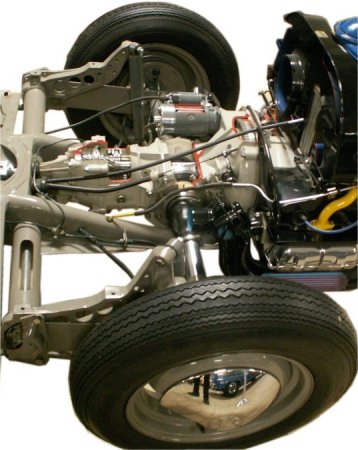
Below the associated rear axle. Even more effort is being made. There is not only a cross tube that contains the springs, but also a kind of easily twistable trailing arm and a sophisticated mount for the damper. They
did not trust the also quite stable attachable body. Conversions to buggies have benefited.
No, as a subframe, such connections between the suspension and the body they are only called, since the latter has become self-supporting. Of course, not all have such a construction on board, most prominent
example: the VW Golf 1. The rear has the already mentioned twist-beam axle. At the front, the wishbone and strut are simply bolted to the body.
Now disadvantages of the subframe are already visible, because this Golf without was one of the exemplary lightest, VW has ever built, comparatively little consumption and good power delivery even relatively small
engines were the result. Of course, now you can ask why VW has used the subframe of this type too soon?
Which brings us the benefits. Let's take a little detour and listen to Dipl.-Ing. Karl-Heinz Baumann at youtube, former Head of Passive Safety at Daimler-Benz too, when he reports about three different discussed ways to
a then new body of the W 140 (S-Class) to achieve more comfort and solidity.
The first possibility considered was a so-called perimeter frame, so again the separation of body and chassis, the latter especially the lateral outer longitudinal spars reinforcing. Because 'peri' is interpreted in ancient
Greek as much as 'outside' (Wikipedia). As a second option larger sheet thicknesses and as third very thin sandwich sheet metal constructions with plastic layer in between were tried out. Last proved to be light, but
difficult to deform in press lines.
So the body remained conventional, but received a comparatively huge subframe, the engine and front axle containing and despite its sound-absorbing suspension by a strong connection to the spars outside in the
case of an accident could derive forces in this. The type of suspension has thus given the definition and distinguished the subframe from a integral carrier integral with the chassis.
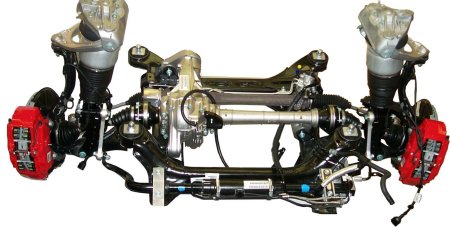
So noises and vibrations from the road and engine it should stop. It is now more popular than ever, eg in SUVs like the Porsche Cayenne (picture above). For example, there is the current Ford Focus as ST rear with
multi-link axle and an additional subframe behind although the basic model is equipped only with a twisted beam axle. Presumably, this stabilizes the chassis, which has a positive effect on the chassis.
|