|
 Detroit Diesel Detroit Diesel
| Detroit Diesel |
| Typ | kW | rpm | kg |
| 2-71 | 50 | 2.000 | 435 |
| 3-71 | 67 | 2.100 | 692 |
| 4-71 | 118 | 2.100 | 807 |
| 4-71T | 140 | 2.100 | 830 |
| 6-71 | 175 | 2.100 | 993 |
| 6-71T | 210 | 2.100 | 1.016 |
| 6V71 | 175 | 2.100 | 912 |
| 6V71T | 204 | 2.100 | 943 |
| 8V71 | 234 | 2.100 | 1.048 |
| 8V71T | 266 | 2.100 | 1.132 |
| 12V71 | 350 | 2.100 | 1.415 |
| 12V71T | 407 | 2.100 | 1.610 |
| 16V71 | 467 | 2.100 | 2.086 |
| 16V71T | 533 | 2.100 | 2.177 |
They are no lightweights.
What does a Detroit Diesel actually mean? It was founded by General Motors in 1938/39 and later changed its name variously. In the meantime it was associated with the Penske Corporation.
Finally, with its road vehicle division, it ended up under the umbrella of Daimler Trucks North America. We want to take a look at the technology of a particular engine series. So sit back
back and forget some of what you know about Diesel engines.
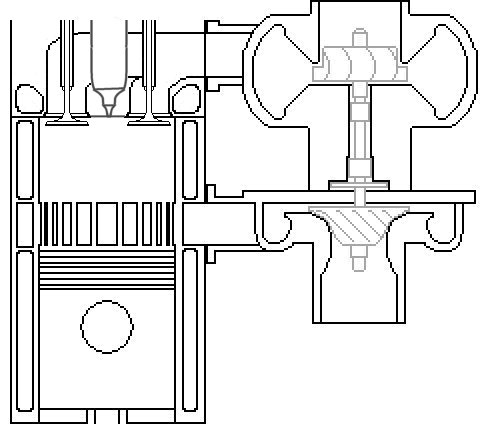
The 4.71 works on the two-stroke principle. That sounds rather unusual to European ears. In our country, this is almost exclusively found in very slow-running, huge ship engines of up to 100,000 hp. The 4.71, however, is a
rather normal engine for the truck sector, among others. In it, the piston opens slits all around the cylinder on its way to BDC, which act as an inlet. Air enters the combustion chamber through these openings, which, if the
exhaust valves open at the same time, transports any combustion gases out.
There is the 4.71 with and without a 'T', which means 'turbo'. At this point one wonders for the first time, but by no means for the last, because in order to completely flood the combustion chamber with fresh air, a certain
amount of pressure is required when the piston releases the openings distributed all around the cylinder chamber. The solution to the puzzle: The 4.71 without 'T' has a
has a Roots compressor instead of the turbocharger, always with lower power, by the way.
Also for easier overhaul of the engine, the cylinders have dry liners, not wet ones as used to be the case in our trucks. This means that the coolant is located behind another wall, as part of the cylinder block. At the bottom of
the slots, the liner is surrounded by a space called the 'air box'. Liquid components collected in the fresh air pumped in by charging at the bottom of the box must be discharged through a valve into a container.
The valve makes this possible without letting the boost pressure drop too much. It needs special attention. We don't go any further down because this is where it finally looks like we are used to. The connecting rod drilled
through for an oil line is also part of it. This is still extended through the piston pin into the upper part of the piston. On the outside, the piston pins are sealed on both sides by plastic washers, the tightness of which is
checked during an engine overhaul.
The piston itself is divided into two parts, the top is made of an alloy that is resistant to heat and to traction, the bottom is a so-called 'shirt' with good sliding properties. The upper part forms with the 'crown' the lower part of
the combustion chamber, not unlike the piston chambers we are used to. Interesting the compression rings on the part shown above, one of them at the highest possible position. At the very bottom of the shirt, two oil
scraper rings. The equipment varies depending on the compressor or turbo model.
Mind you, the lower part looks like an upside-down piston, but it is open at the bottom. From there, you can reach two screws that connect it to the part at the top. There is just enough room for both of them next to the piston
pin. This is screwed to the connecting rod shaft at the same time. So there is no upper connecting rod eye. Again, there are differences in dimensioning between the turbo and the compressor. The two parts of the piston
are
sealed against each other by an O-ring at the highest point of the skirt.
Even more complicated is the sealing of the liners at the top against the engine block and the cylinder head at the same time, consisting of special individual rings. At the very top of the block, the camshaft, which not only
operates the four valves via cup tappets in the head and two rocker arms with bridges, but also the pump nozzle via a third cam per cylinder. This fills the space between the four valves and their exhaust ports almost
completely and is even liquid-cooled.
And where does the 4.71 get its designation? Well, first of all, it is a four-cylinder engine with a displacement of 4.7 litres. That is the equivalent of 284 cubic inches, which results in an individual displacement of 71 cu in.
The
special thing about it is that an entire series is named after it, i.e. they all have the same displacement per individual cylinder. Gradually, the in-line engines from one to six cylinders were joined by V-engines from six to
twenty-four. So the smallest has been a 6V-71.
The rationalisation goes even further, namely there is no 10V-71. Why not? Because there is no 5V-71. Because the V-engines have the same cylinder heads. So the 12V-71 uses four cylinder heads of the 3-71, the 24V-71
four of the 6-71. The prerequisite, of course, is that in the two cylinder banks of the V-engines, unlike usual, one camshaft each does its job. So, now you should be able to imagine the more modern 53 and 92 series from
Detroit Diesel for yourself.
| Where else has been designated the engine according to its individual displacement? At Ferrari, of
course. |
|
|