Number of gears (1) Number of gears (1)
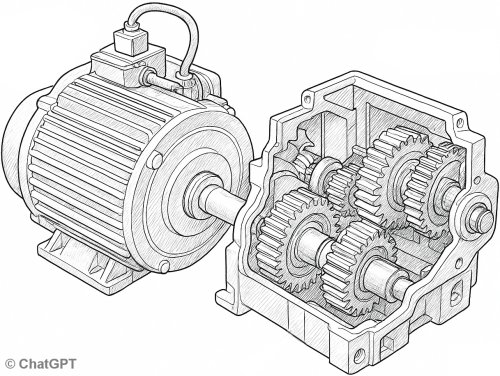
Would you have ever dreamed that in the foreseeable future, people would be able to expatiate about the number of gears in electric cars? A transmission behind the electric motor, why? Actually, people were happy that
the electric drive was so wonderfully simpler than that of the combustion engine.
Or is this just another form of overengineering by German manufacturers? Some examples: A Mercedes eActros apparently needs four gears, while an Iveco S-eWay apparently manages without them. A Porsche Taycan
has two, while its competitor, the Tesla Model 3 Plaid, only one. Why is that?
Meanwhile we have to learn that an electric motor can deliver a decent amount of torque from zero speed to the highest speeds, but by no means does so at the same rate across all speed ranges, especially when it
comes to its behavior at partial load.
Now, one can simply decide to design the gear ratio so that this maximum efficiency is in the range of, say, 130 km/h on the highway. It's also not to be expected that an additional gear will be introduced for efficiency at 100
km/h. For the electric truck, one could plan for 80 km/h.
But then the first hurdles arise, such as the question of whether empty or loaded with 22 tons. Well, it would be relatively easy to choose the latter. Besides, the two ranges are too close together here, too.
If we look at the passenger car sector, Porsche and Tesla are clearly all about performance. This includes not only top speed, but also acceleration. And here we are definitely so far apart that two gears might be
worthwhile.
Porsche does that, Tesla puts more strain on the engine and has hopefully made sufficient provisions for that. And the same is true for the Iveco. It has a peak power of 840 kW, while the eActros 'only' delivers 600 kW. It
supposedly compensates for this with its four gears.
With electric cars, we have always wondered why they have such a conspicuously low towing capacity. Now we know: it's the lack of traction at the bottom end, probably especially when starting off. It's like a combustion
engine trying to start with a trailer in top gear.
Even worse, actually, because the electric motor provides the high torque, but while in a combustion engine it increases slowly with increasing engine speed, in an electric motor it is present all the time, meaning heat is
generated. Temperature seems to be responsible for such an electric motor switching back to normal power.
With a truck, it's even worse. After all, you have to expect it to be loaded. We don't know how Iveco manages this; after all, the S-eWay sprints like a madman even when loaded. Perhaps the thermal management is quite
sophisticated.
Mercedes would not tolerate not having a similar thermal management system. But the point is actually something else. Because, of course, too much heat indicates irregularities in efficiency. Mercedes would, probably
rightly, point to lower fuel consumption.
This is the best reason for transmissions in electric cars. You start with the gear for maximum efficiency at 130 km/h (81 mph) and then increase the gear when the expected torque becomes too low. However, this only
works if the car doesn't need to go too fast. Very fast and sporty vehicles are excluded here.
|