Engine technology 3 Engine technology 3
This chapter is about the reluctance motor, which has actually been known for a long time, but is probably a technology with a future because of its enormously greater efficiency. There are already companies
like Tesla that use this label to describe their engines, but be critical.
A real reluctance motor contains neither a conductor cage nor magnets in the rotor. Because reluctance is the ability to do everything possible to be exactly aligned with the next best field line. Although
reluctance has something to do with magnetism, it is not based on the interlock of two magnetic fields.
Actually it can only be recognized from the outside by its rotor, while the stator is similar to that of a synchronous or asynchronous motor. So we're dealing with its rotating magnetic field again, only this time its
control is a little more demanding. Until recently, this type of engine for heavy loads did not exist.
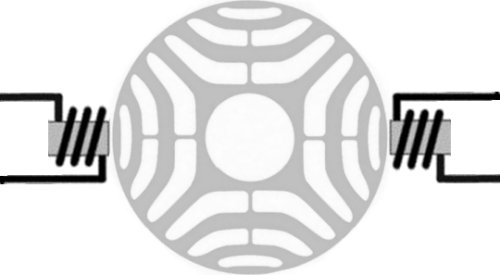
To explain the phenomenon, the compass needle is often used, which always tries to adapt to the course of the magnetic field. The position shown above is comparable to the position targeted by the compass
needle. If the rotation of the rotor deviates even a little, a force is created to restore the situation above.
Of course, two pairs of poles would fit the rotor above. And this number is by no means binding for the reluctance motor. As with synchronous motors, the only important thing is an even number of poles. But
what is immediately noticeable is the alignment of the arrangement of the transformer sheets in the rotor with the respective pole pair.
They are cast as a whole in the rotor and clearly follow the course of the field lines as they are generated by the magnetic field of the respective pole pair. Somehow we returned to the synchronous motor, albeit
with significantly better efficiency and the ability to switch it off completely. What remains is the synchronicity between the rotating field in the stator and the movement of the rotor.
It's even more difficult because a reluctance motor actually can't start by itself. This requires sophisticated control of the rotation of the magnetic field together with feedback of the respective speed of the rotor.
Perhaps this is also a reason for the long-standing reluctance to achieve higher performance with this motor.
The rotor also has certain requirements. The rest of the crucial two quarters should not be shaped in such a way that it tries to follow the field lines of the respective pole, but should actually disturb as little as
possible the processes emanating from the reluctance force to align with these two. Presumably here is also a limit for the number of fields in the rotor.
kfz-tech.de/Ye218
| English subtitles possible . . . |
kfz-tech.de/Ye219
|