Wheels - Spoke rims Wheels - Spoke rims
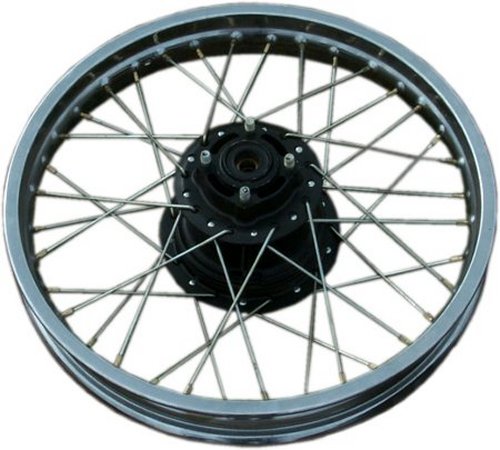
The one above is 'just' a pure two-wheeler rim, but not as complicated as one for a car, although it may have fewer spokes. It is, of course, a much-noticed adornment of a vintage car, for example. Nevertheless, you should
heed the advice to seek professional help when replacing or renewing spokes.
Of course, it's all just screwed. But the trouble begins when determining certain dimensions. Take, for example, the wheel offset that you should ideally have on paper for such a car. If this is not the case, you can take it from
the original rim using a nice, straight piece of wood. If the hub gets in the way, you can use two additional spacers.
But what do you do if the two are different? Then you have to buy new spokes. If you still have the originals, you can use them as a sample. Hopefully they really are the right ones and there were no bunglers at work. And
what do you do if there are no spokes left at all? Sometimes there are two possible lacing variants for one and the same rim.
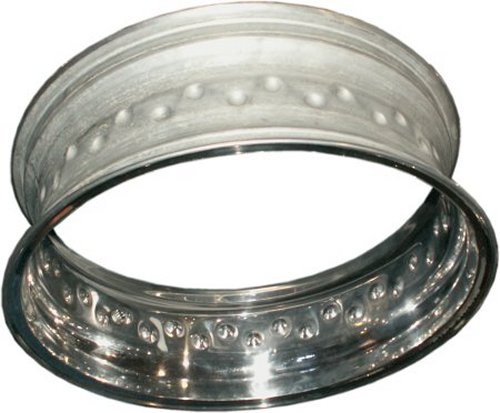
Have you already mastered these problems and have clear indications on your rim as to which opening there matches which on the hub? Also, do you know that on each side of the hub the spokes in one direction alternate
with those in the other? Then all you need at this point is the certainty that the spoke threads do not protrude beyond their nut (nipple).
Actually, the problems only start when you think you're almost done with the lacing. You clamp the product and test the concentricity. Result: There is both vertical and lateral runout. Yes, of course, you didn't expect anything
different. We can ignore the order of elimination here because we want to point out a completely different problem.
Imagine that after some trial and error you have actually managed to eliminate both lateral and vertical run-out. The remaining nuts are also sufficiently tightened. Is everything OK now? Of course not, because we all know
how such an adjustment is made. If the rim moves to the left at a certain point, the spokes pulling to the right must be tightened more.
But what do we do with the spokes pulling to the left? Do we reduce these in an appropriate extent or do we overstrech them? Even worse: the vertical runout is present at a specific point. Can we really tighten it continuously
until the maximum deflection or are it individual spokes that do the main work here and are at risk of breaking later?
We tighten screws with torques down to 5 Nm. Do we also use a torque wrench for the spokes? Are there any values for this? If you ask me, you can do the whole thing like this for a bicycle or moped, but with an appropriate
tool: a kind of open-end wrench, twice as thick as normal. And when spokes break, you have an indication of an fault. But please don't do that for e.g. a sports car, for example, if you value your life.
After all, the mass distribution and its balancing do not play a role. In a car you actually have to compensate for the imbalances of the rim and tire against each other. Such rims are beautiful, but they need professional care,
perhaps even if it is just the case of cleaning, chrome plating or partial replacement.
|