|
 Wheels - Tire Manufacturing Wheels - Tire Manufacturing
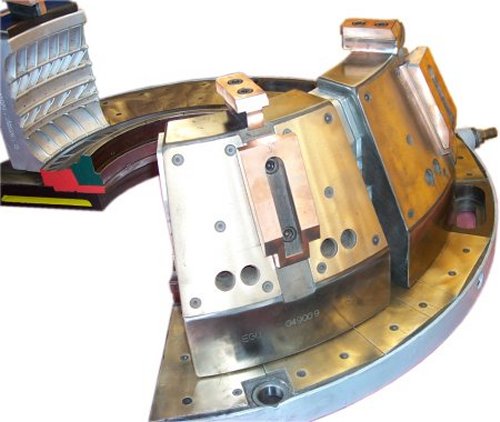
Admittedly, the picture no longer shows the latest status, but it does point to one of the most important steps in tire manufacturing. We put the cart before the horse, so to speak, by first showing the last major step (without the
cooling and final inspection of the tire), the vulcanization.
As you have already noticed, the process here is based on heating, there is also cold vulcanization. If you look very closely at the picture, you can see a small cross-section through the lower plate on the left-hand side,
roughly in the middle. It has a circumferential cavity through which hot water or steam circulates via the connection at the top right and thus ensures a certain temperature.
The temperature (e.g. 180°C) and above all the heating time (e.g. a good 10 minutes) have a considerable influence on the later properties of the tire. Its size must also be taken into account. All in all, vulcanization has the
task of not only baking together the various substances that make up the tire, but also fundamentally changing the properties of natural and synthetic or artificial rubber, for example, in the direction of much more elasticity.
The heating press above is also intended for a blank with a running tread but without a profile, during which the complete profile can already be obtained in the tire building process, precisely calculated and applied, so that
only slight manual corrections at the interface between the beginning and end of the tread are required. The color also comes into play here, a kind of marking to check the correct assignment.
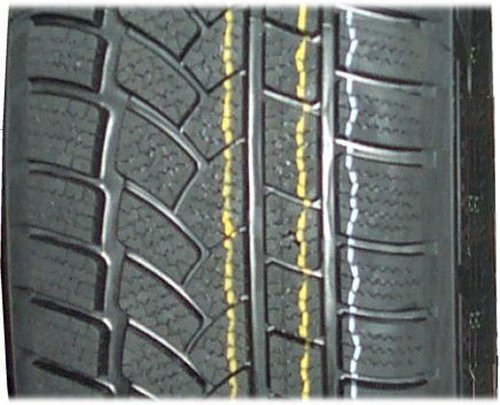
One can see from this that the tire is assembled from two parts during production just before vulcanization. Basically it consists of steel wire, textile cord and rubber mixtures, but the latter are divided into more than ten
different ones. When they are manufactured, you always have the feeling that they have already been rolled out, but there comes always a cutting edge, splits and sends the strips again under heat to the mixing and selecting
process.
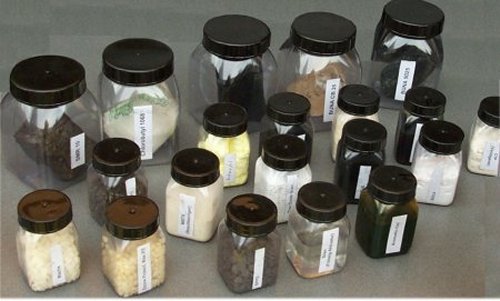
Here is a selection of substances that come together in addition to natural and synthetic rubber, e.g. carbon black and silica, which give tires certain positive properties. The later useful life is already also influenced here. The
inner part of the tire is created flat and fully automatically on a drum. The later inner layer, which nowadays replaces the tube, comes first. Then the textile cord is applied with a fiber flow 90° to the running direction. It largely
determines the behavior of the tire sidewalls, e.g. the level of comfort.
The bead has always consisted of steel wire enclosed in a layer of rubber. In addition, further inlays are possible, the larger the permissible speed range is. Basically, the inner tire is done with it. As a kind of short rubber
tube with a relatively large diameter and two thickenings on the sides, it bears still little resemblance to a tire. For this purpose, it is later connected to the tread part by inflating it.
Incidentally, this one has a different rubber compound, better adapted to the requirements of the tire on the road, such as braking behavior in the wet. This part of the tire is also made from the inside out, starting with usually
two layers of steel wire for cars and four layers for trucks, which is protected from corrosion by a layer of brass and covered with rubber. It can also be manufactured in another part of the group. It can also be manufactured in
another part of the factory. When the tread is applied, the tire either already has a profile or it receives it during vulcanization.
|
|