|
| 
|

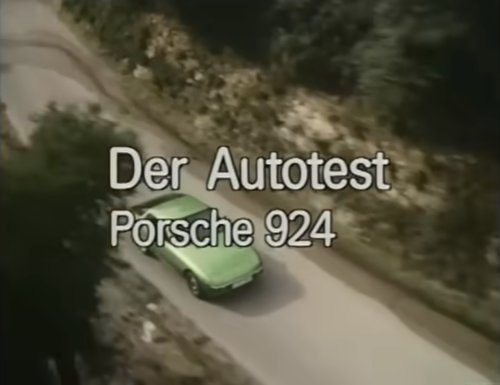
1975 Porsche 924
Inline four-cylinder, 1.984 cm³, 86,5 mm * 84,4 mm, compression ratio, 9,3 : 1, OHC (toothed belt), mixture preparation K-Jetronic, torque, 165 Nm at 3000 rpm, 92 kW (125 HP) at 5800 rpm, front
engine, longitudinal, Transaxle principle, four-speed, five-speed and three-speed automatic (from1976), body, hot-dip galvanized, wheelbase 2.400 mm, length 4.213 mm, width 1.685 mm, height 1.270 mm,
drag coefficient, 0,36, front suspension McPherson-suspension struts, coil springs, rear suspension, semi-trailing arm, torsion bar springs, steering, gear rack, brakes f/r, disks, ventilated, drums, two circuit,
brake booster, tyres, 165 HR 14 (5,5'') 185/70 HR 14 (6'') (optional), kerb weight 1080 kg + driver, payload, 320 kg, tank capacity, 66 liters, a good 200 km/h, manufactured, 1975 - 1988, purchase price, from
23.240 DM, electric system, 12 V/ 45 Ah/ 1050 W, oil change, every 10,000 km; maintenance, every 20,000 km.
It was a development project by Porsche for VW, one of many such projects up to that point, this time designated EA 425. But the conditions for that had changed. After several prosperous years for the
Beetle, VW was in deep trouble.
At literally the last minute, they had scrapped the Beetle successor, which had also been developed by Porsche, and adopted the front-wheel-drive, transverse-engine layout specified by Audi. At least they had
already come to terms with the disappearance of air cooling.
But Porsche had gone down the path of rear-wheel drive. The plan for VW would actually have been a transverse engine mounted in front of the rear axle, which might not have been the best fit for a sports car.
But Porsche probably couldn't get by with just a standard powertrain.
In the meantime, VW had created its coupe, the Scirocco, which was simply the Golf with a different body, so there was now neither a need nor any additional funding. Added to that was a plant that is once
again among the candidates for closure: Audi Neckarsulm.
Porsche, on the other hand, needed an entry-level car. In the meantime, prices for the 911 had skyrocketed, and those for the 928 were now 50 percent higher. So what could have been more natural than to
release this car as a Porsche?
Yet its predecessor, the 914, for example, had even more Porsche parts on board, such as the transmission. Nevertheless, the new four-cylinder model was boldly named 924, related to the 928 with its eight
cylinders. And the '9' at the front remained the hallmark of Porsche.
The claim that the 924 shared its engine with the LastTransporter simply cannot be accepted. After all, the cylinder head and mixture preparation are different, which resulted in 37 kW (50 PS) more power
despite the same displacement.
The 924 was certainly not what some used to call a 'housewife’s Porsche' - the nickname once given to the Karmann Ghia. And it reportedly sold better than any other sports car—probably best of all in
the U.S., where people don't operate as strategically.
The transaxle design was interesting. The clutch remained at the front, near the engine, but the rear transmission was also sourced from the Audi front-wheel-drive model. The second clutch bell housing was
retained so that, starting in the fall of 1976, it could also accommodate the torque converter for the Audi automatic transmission.
Unfortunately, the rear clutch housing, which is empty in the case of a manual transmission, took up height, resulting in a fairly high trunk floor. Perhaps that was also the reason for the rather tall, glass
tailgate.
The transaxle concept was strongly supported by Porsche, as it offered a way out of the impasse posed by the air-cooled rear engine without having to sheepishly follow in the footsteps of other manufacturers
with front-engine/rear-wheel-drive designs. In a sense, one remains independent when it comes to technical solutions.
In addition to improved weight distribution, advantages regarding vibration characteristics were cited. The engine, the cardan shaft in a connecting tube, and the transmission, together with the exhaust system,
form a single, rigid unit that even incorporates the battery, located at the rear left.
The entire assembly, featuring a two-meter-long cardan shaft, could be better decoupled in terms of vibration; the shift mechanism, which was also rigidly guided, was more cost-effective; and in the event of a
crash, the engine block does not penetrate the passenger compartment but actually absorbs additional energy.
However, the 924's powertrain was not known for being particularly quiet. On the other hand, it excelled with its consistent torque. Porsche engineers made it a bit more suitable for a sports car by increasing
the compression ratio and adding K-Jetronic.
However, it still offered a wide usable rpm range, and given the oil price crisis that was rampant at the time of its development, it was designed with a long gear ratio, which resulted in fuel consumption figures
ranging from 7 to 13 liters per 100 km. The aerodynamics, which were good by the standards of the time, also contributed to this.
One advantage that hasn't been mentioned yet is the relatively high load on the drive axle, combined with the decoupling of the drivetrain and the steering system. That's why only positive reports were to be
expected regarding the chassis. It was neutral and not easily thrown off balance, and it didn't have the tendency to spin out that was so feared with the 914.
Only the brakes were criticized because of the rear drum brakes, but they would have been suitable for a VW sports car, since at that time almost only the expensive disc brakes with integrated hand drum
brakes would have been an option. The VW fan on a tight budget didn't have to miss the 924, after all, he had the Scirocco.
|
|