Porsche 550 Spyder
550 Spyder, flat four cylinder, 1.098/1.498 cm3 (73,0/85,0 mm * 66,0 mm), compression ratio, 9,5 : 1, engine control 2 * dohc, king's shafts, 2 dual-fall-flow carburetors,
torque -/119/145 Nm at -/5000/5900 rpm, 68/81/99* kW (93/110/135* HP) at 5500/7800/7200* rpm, midsized engine, longitudinal, rear drive, locking mechanism, four-speed plus starting gear*, front suspension, crank
handle, torsion bar suspension, rear suspension, double-jointed pendulum axle, lower mounting*, torsion bar suspension, Ross steering, brakes, drums, light metal, later front Duplex, wheels f/r, 5.00 - 16 / 5.25 - 16,
wheelbase, 2.100 mm, length 3.600/3.700* mm, width 1.510 mm, height 880 mm, body, aluminum, drag coefficient 0,31, tank capacity, from 68 liters, kerb weight from 550 kg**, 200/220/240* km/h, electric system, 6/12 V/
160/216 W, 1953-1957, production 118 cars, purchase price 18.500 DM (1955), *Spider A **Coupé
Watch the video above and enjoy the different perspectives. We don't entirely agree, especially with the way the restoration was carried out. We asked ChatGPT
how much a car like that might fetch at auction: 4 to 8 million euros.
So far, so good. But the fact that a car like this - which was originally hand-hammered - is being filled with body filler because of a crack near the headlight is unbelievable. This car fails
every thorough paint thickness test.
With a car this valuable, you’d expect the engine to be disassembled and partially overhauled before being started for the first time in 15 years, rather than starting it up and then draining the oil out of the exhaust.
Unfortunately, the interesting part of the performance measurement is hidden.
Enough with the criticism. Let’s move on to the next point: the often-told story of James Dean’s death in an accident involving the 550 and the miraculous survival of his passenger, Rolf
Wütherich, which you can watch in the last video.
Now, let's talk about this beautiful car. The Spyder 550 was created on the initiative of Helm Glöckler, a VW dealer from Frankfurt who won the German Road Racing Championship in 1952 with his custom-built car.
He showed Porsche what was possible with the 356 technology.
Porsche then developed the 550 with a 1.5-liter engine and sent Richard von Frankenberg to Le Mans. Glöckler competed there with his car in the 1,100cc class, and both of them won in their respective classes. The first of
more than 40 victories in international races.
In 1954, Hans Herrmann finished third overall in the Carrera Panamericana, behind two Ferraris, and narrowly edged out the third Ferrari for fourth place. It was David with four cylinders against Goliath with twelve.
Yes, it was light and easy to handle. It was the almost neutral behavior of a mid-engine car. As long as the tank was full, the axle loads were almost evenly balanced. The emptier it got, the more lightweight it became, and
so did its steering.
As the fuel tank grew larger, the spare tire was also moved to the rear, above the transmission. Hans Herrmann reported that the 550 was so low to the ground that he and his co-driver, Herbert Linge, once managed to
drive under a closed railroad crossing barrier during the Mille Miglia.
Actually, the Coupé was superior to the Spider in terms of aerodynamics, but in racing films featuring Porsche’s successful performances, only the Spider ever appears. The first Spiders still had a flat tubular frame as a
subframe; later, the frame supported the entire body.
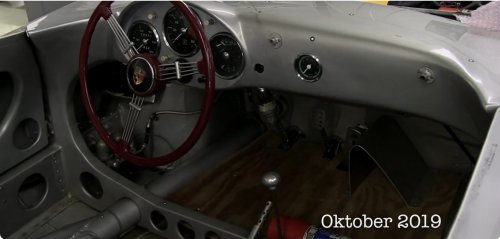
That meant losing several more kilograms. Additionally, the dashboard was welded in place to provide extra support against warping. The drum brakes and the entire suspension system
were also continuously improved in order to hold their own against increasingly fierce competition.