Porsche 915 transmission Porsche 915 transmission
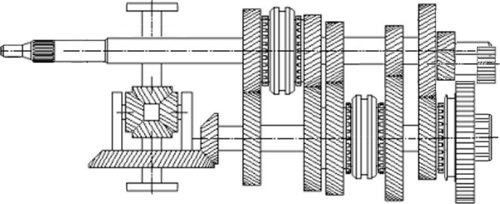
The schematic diagram of the 915 transmission shown above is introduced with the 2.4 liter engine. When the displacement is increased, a higher torque is usually produced. Of course, a Porsche, and
especially the 911, has experienced this more often since then. A good example would be the change to 3 liters and even more so the introduction of the turbo.
Where are the problems? In addition to the width of the gears and the diameter of the shafts, the bearings also have to be adapted to the new conditions. The design of the lower cover on the axle drive on the
left shows that dimensioning is not always the only solution to such difficulties.
If you look at the bevel gear and ring gear for a while, you can easily imagine that the downward pressure on this cover, so in practice outward pressure, can be particularly high. The first ones, like the
housings, were cast with a high proportion of magnesium, technologically still derived from the Beetle. Greater stability is achieved here not only through stronger ribbing, but through aluminum too, possibly
also subsequently hardened.
Let's look at the gear speeds. Top left is the shift sleeve for fourth and third gear, below that for second and first gear. At the top left is the shift sleeve for fourth and third gear, below that for second and first
gear. So no more shifting pattern with first gear in a separate shift gate on the left. There is a gearbox with four and five gears. The fifth gear was added behind the right gearbox wall.
Our picture clearly shows how the fifth gear is shifted, namely in the same direction as gears 1 and 3. With the four-speed gearbox, only the reverse gear is located here.
Its function is a little difficult to understand because first the shift sleeve with the straight-toothed pinion on it has to be moved in the direction of gears 2 and 4 and only then is it connected to the small auxiliary
shaft with a straight-toothed wheel on the right and a helical gear on the left.
Our picture clearly shows how the fifth gear is shifted, namely in the same direction as gears 1 and 3. With the four-speed gearbox, only the reverse gear is located here. Its function is a little difficult to
understand because first the shift sleeve with the straight-toothed pinion on it has to be moved in the direction of gears 2 and 4 and only then is it connected to the small auxiliary shaft with a straight-toothed
wheel on the right and a helical toothed on the left.
Up to this point, it was actually normal transmission technology. The synchronization is a bit special, because one like in our old Kadett gearbox in the picture below does not work with the 915 gearbox. As
with the Beetle right at the beginning, they resorted to the locking synchronization developed and patented by Ferdinand Porsche, which can only be explained because at the time of its invention,
synchronization for manual transmissions was still relative.
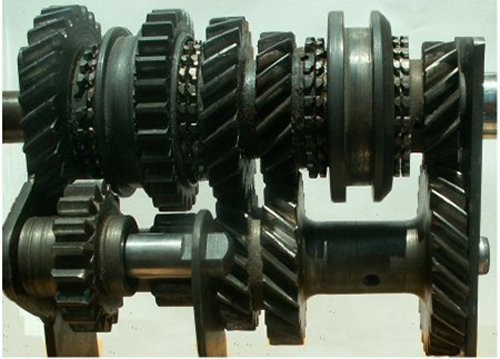
You already can see it in our sketch above. There are no synchronizer rings, which is clear from the fact that there is only one pre-toothing in front of each gear wheel, as opposed to two in the picture below. In
this system from Borg-Warner, the teeth of the synchronizer rings are positioned in front of the gaps in the pre-toothing as long as both have unequal speeds. Only then is the path cleared for changing gear.
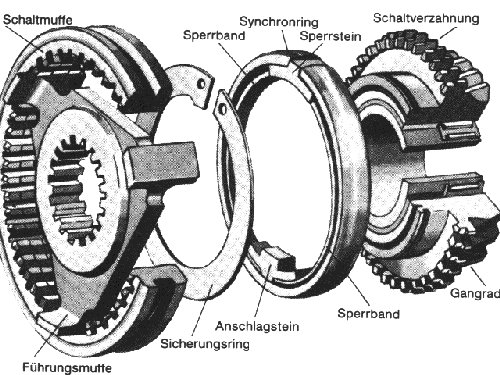
The Porsche locking synchronization, on the other hand, works with locking bands that are held between a locking block and a compensation block. If there are differences in the speed, the distance between
the locking stone and the stop stone decreases and the locking band presses the slightly springy synchronizer ring surrounding it outwards, which makes it more difficult for the shift sleeve to slide over into
the pre-toothing.
Actually, this is not a real locking synchronization because, unlike today's designs, there is no real locking. Put simply, you can tear over the gear insert. Although this is also possible today, the teeth of the
shifting sleeve are always positioned on the tooth spaces of the pre-toothing before positive locking.
In addition, wear on the synchronizer rings is more difficult to assess because of their spherical shape. The friction surface has always been smaller, especially with the
recent emergence of multiple friction surfaces. Porsche's lock-up synchronization is also criticized for having longer shift travel.
They stuck with the system for a long time, longer than VW, for example. It was originally widely used, including in many foreign brands. But there must have been
a reason why everyone finally left, including Porsche.
|