Tow a car Tow a car
kfz-tech.de/PHB46
Americans are strange people sometimes. No, not because some of them indulge in luxury without restraint, so do others, too. Rather because they have such a significant approach to technical problems. However, we
cannot judge here whether this also extends to other areas of engineering.
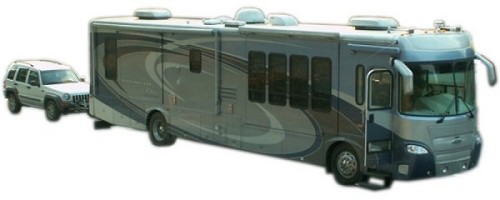
Depending on the legal situation in individual american states, a jeep running behind a bus, no matter how large, can be completely unbraked. The drawbar between the pulling and towed vehicle is all the more stable. Of
course, this also applies to their attachment to the latter.
And yet, it will never be enough when you consider that in Germany, for example, a trailer with a permissible total weight of more than 750 kg must be braked. Below you will find such a simple connection to a vehicle
combination obviously from Great Britain. Here even the auxiliary wire rope is forgotten in case the connection breaks.
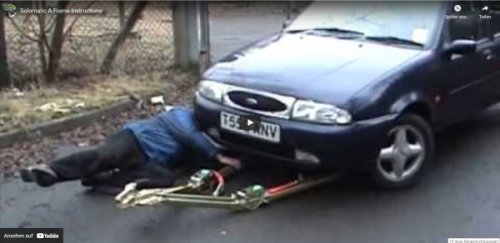
However, the video is a good example of how something like this can be produced with simple means. There are large openings in the lower wishbones to which the drawbar is attached with additional chains and tension
belts. In principle, the towed vehicle remains completely unchanged. The Americans use something like that, for example, when they move alone with U-Haul and want to take their car with them.
Also, in the example below, the vehicle's electrical system is not used and a crossbar with all the necessary lights is simply attached at the rear. As you can already guess, integrating something like this and installing a
socket or a cable to the well-known connection on the trailer hitch means a lot more work. It is questionable whether a CAN bus will help here.
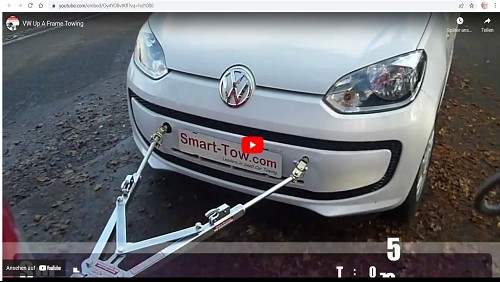
Also, vehicles like the jeep with a ladder frame usually have easily accessible pivot points for the drawbar. With the VW-Up or its relatives, the front cross member has to be provided with elaborately welded threads. In the
USA, some of the construction may protrude to the front, in Germany, for example, that would not be allowed.
The sellers of such drawbars complain that such practical inventions are not allowed to be sold in this country, but well in England and the Netherlands. No, not everything that is permitted in one EU country must
automatically be recognized by another, e.g. the car trailers with longer wheelbases and hydraulic brakes that are so popular in the Netherlands.
kfz-tech.de/PHB47
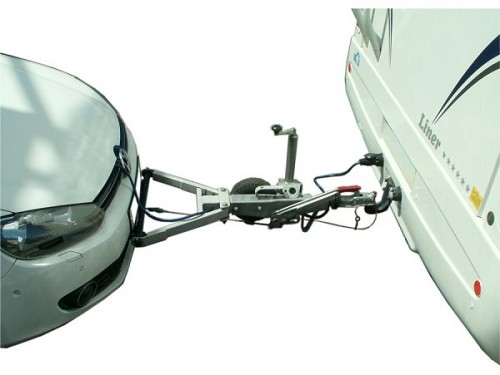
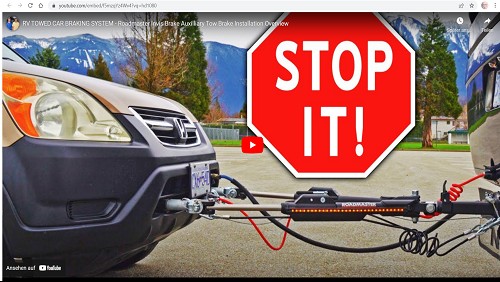
This brings us to the point why we mention the construction in this book. The existence of braking functions can usually be recognized by the much lighter drawbar. It is always the service brake of the towed vehicle that
operates here. Unfortunately, when the engine is switched off, there is no negative pressure for the brake booster.
Originally, this was then generated in the towing vehicle, which is actually not a relief either, because a diesel engine is usually at work there. Negative pressure is also somewhat more difficult to conduct between the two
vehicles than positive pressure. One has learned from this and are now generating electrical pressure in the rear vehicle.
Relatively high up, so that it doesn't get in the way, a pressure cylinder then presses on the brake pedal, strong enough even without brake booster. Special electronics react extremely sensitive to any delays caused by the
main vehicle. The tuning can also be adjusted later. There is also a switch to turn off the system.
Of course, the battery is continuously charged while driving from the front. You can watch it all again in the last video. The adjustability and subsequent fixing of the drawbar is also briefly displayed there, so that fewer
shunting trips are necessary. And if you haven't spent enough money yet, you can also have the rods equipped with LEDs.
When you see the construction for the first time, you think the drawbar is attached to the tie rod. However, this is usually impossible and aside from that the fixed connection to the chassis is sufficient. If everything on the
towed vehicle is unlocked, the steering obediently follows the track of the towing vehicle. This is probably due to the wheel geometry, which also ensures that the steering returns to the center after the corner.
We still don't quite understand how it works with reversing, for which there are several YouTube proofs. In addition to some assumptions about the chassis geometry and the caster of the tires, there is a very plausible
answer. The retrofitted control unit should notice the reversing and apply the brakes slightly. The retrofitted control unit should notice the reversing and apply the brakes slightly. In any case, the result is impressive.
kfz-tech.de/YHB8
kfz-tech.de/YHB9
kfz-tech.de/YHB10
|