Hydraulic Brake - Brake-by-Wire 1 Hydraulic Brake - Brake-by-Wire 1
If you are dreaming of a much simpler and thus more cost-effective brake system on this topic, for example with the foot pedal simulated brake pedal and purely electrically operated wheel brakes, the omission of any
liquids and thus their replacement intervals, then this is technically quite legitimate, but unfortunately not legally enforceable.
As with steer-by-wire, there is still a fallback level, which in this case consists of master cylinder with reservoir at least for one circuit and hydraulically actuated wheel brakes. However, only the front brakes seem to
comply with the legal requirements. You have to let it melt in your mouth, an S-Class with only braked front wheels, if brake-by-wire fails.
But that is not the only problem. Anyone who has ever used the first brake boosters from Mercedes or, even worse, with the button-like brake pedal of the first Citroën ID/DS, knows how much you can miss the
metering
of a brake by the pedal pressure. So the Sensotronic Brake Control system has a solution, but that makes it even more complicated.
Whether the term 'pedal travel simulator' is the right term for this, the Bosch people need to know. In any case, the driver gets the best possible simulated feeling that he/she would have when operating a purely
hydraulic brake. And crazy enough, since we now need brake fluid, we also use it for all wheel brake cylinders.
Although conventional ABS and ESP are eliminated, an electrically driven, hydraulic pump is needed again. Yes, even worse, you need a high-pressure accumulator reminiscent of the aforementioned Citroëns.
Overall, the system is not so much larger, as you could guess from the text here, cheaper by no means.
In normal driving without interference, the master cylinder is separated from the front wheel brakes. It passes its pressure exclusively to the pedal travel simulator, which provides for appropriate back pressure. Of
course, a vacuum or hydraulic booster is missing. At the same time, however, the pedal travel is of the utmost importance for the activation of the brake.
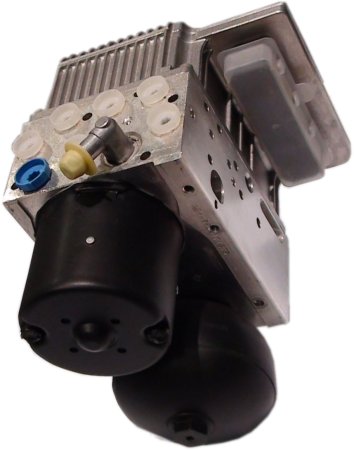
To the other inputs in the control unit and their processing later more. Since no pressure is expected from the brake master cylinder, it must be generated by the high-pressure pump and stored in a pressure
accumulator (pictured above), because a brake can not wait for an electric motor to start running. This pressure is then passed via modulators to the rear wheels directly and to the front wheels after conversion to the
existing hydraulic circuits.
If you like, that is apparently a four-circuit brake. Questionable, however, if the control unit does not switch completely to emergency operation, for example, if a rear circuit fails. In any case, the purely electrical control of a
brake in normal operation is achieved here with relatively high effort. As we will see, the advantages over traditional systems are enormous, some have even been retroactively integrated into ESP as far as possible.
Whether the application of the brake pads for dry braking of the discs belongs to it? Or whether ESP can put on the brake pads when the accelerator pedal is suddenly released? In any case, the decisive difference is
that not too high a brake pressure is built up here, which may then be taken back with concomitant phenomena, for example in the brake pedal.
Here, all possible data, for example the data available via the CAN bus, can be evaluated and applied directly to the required brake pressure for each individual wheel. This may include the data of a cornering or filtered
out by GPS. Distance radar can be useful for the realization of Adaptive Cruise Control. Overbraking the rear axle is also monitored during partial braking.
SBC is like a kind of safety cocoon, in which hardly anything can happen, at least no malfunction when braking. With its usually faster or better response than most drivers, it gets even more time out for emergency
braking.
It would only have to be affordable for many more vehicles. The rear brake is already often electrically operated by the handbrake anyway. And since only the front of the emergency brake hydraulics would be necessary,
you could save them completely behind. In addition, the emergency braking might also be organized without any liquid.
There must be only a second level. If 48V and 12V systems are useful anyway, you would have two batteries. And thus there would be a fallback, because the legislature does not explicitly require a hydraulic system in
emergency, but only an independent of normal system.
One must not forget that a brake system is needed in the era of electric cars, too. And then there would be a time for the end of the hydraulics.
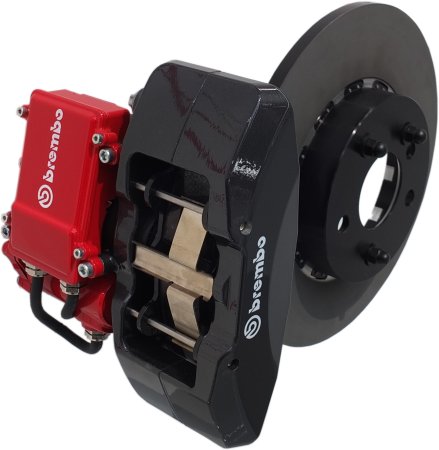
Here is the prototype for a system completely without brake fluid. It is designed according to the manufacturer even for 12V and still 'at maximum power' allow a shorter braking distance. Even the pedal pressure is
'individually adjustable'. Of course, it can be integrated into autonomous driving relatively easier than a hydraulically operating system, just think of the possibility of feedback.
Even the CO2 emissions can be improved by such a system. Not only because it works on demand, but also regenerative braking is much easier and more effectively to be integrated. Instead of two brake
circuits, four redundant brake circuits would result with double redundant design.
|