Hydraulic Brake System - ABS System 5 Hydraulic Brake System - ABS System 5
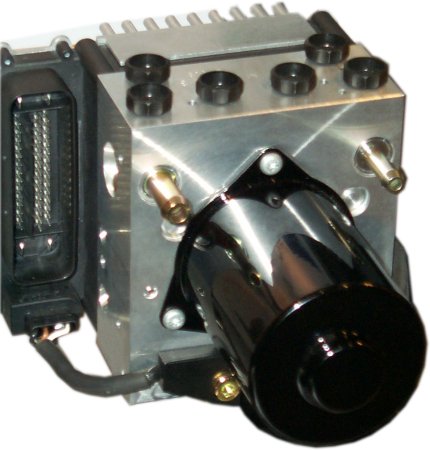
This chapter is called 'Rag Collector'. It offers in loose order the remaining facts about ABS. Above you see a rather early system. One recognizes that among other things by the far outstanding electric motor. For
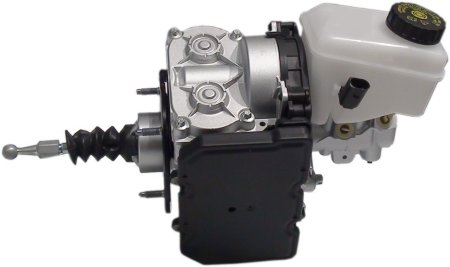
example, Bosch is proud to have scaled down the unit with almost every new model series (picture below). As a result, today it can usually be placed in absolute proximity to the master cylinder.
In the history of ABS is often talked about less than four sensors or channels. So it was possible with diagonal split, with two diagonally arranged sensors only to regulate the two outgoing from the master cylinder lines
and not all four. Or to get along with black and white split (front and rear) and two sensors in front, one behind and the same number of channels.
From this time comes the 'Select-low' principle that even with only one wheel with too much slippage both wheels of an axle are regulated. Conversely, the much rarer 'Select high' allowed a wheel of an axle to block
partially, waiting for the other to reach its limits.
This is largely passé today. We regulate four channels with four sensors, which also allows the system very important interventions when changing to roads with very different coefficients of friction left and right.
Incidentally, what has not been mentioned so far, ABS must be switched off below 8 km/h, so that we can slow down at all to a halt.
Historically a single sensor at the axle drive has replaced two of them at the wheels, but only in rear-driven cars. Even today, it is still possible to have a sensor that indicates either possible connections and/or the
deceleration of four-wheel drives. The problem is a possible, too rigid connection between wheels that would transfer ABS regulations of one wheel to another and thus interfere with the ABS system. Particularly critical
here are one hundred percent locks.
There is also the converse case that drive wheel connections are deactivated for the time of ABS control. If this is fast enough and the ABS control has not to wait, then such a solution is better than the opposite. Also
because of possible transmission of vibrations drive systems can be temporarily switched off.
Looking at the functioning of ABS, overbraking the rear axle is not possible, for example, with much possible payload but momentary empty drive. Nevertheless, manufacturers have installed additional brake pressure
regulators for the rear axle in order to enable a regulation even below the differences in the slip specified by the ABS system, also important depending on the axle load at the rear.
|