Transmission types Transmission types
kfz-tech.de/PGt8
The original reason for introducing automatic transmissions was clearly to provide greater comfort. And then there was another ulterior motive, namely to lure women behind the steering wheel with the much easier
handling of driving a car. Even in 1968, VW printed the manual for the Beetle with such an operating aid exclusively featuring a woman at the wheel. All other reasons are secondary.
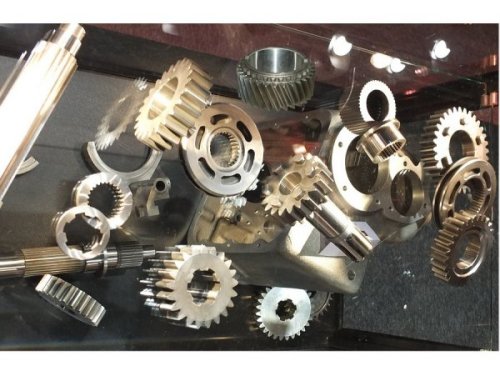
Distinguishing between transmissions is like herding cats. In principle, one cannot even be certain that gears are found in every transmission. After all, with complete manual switches, there is still roughly what was once
invented in the course of the development of the automobile. Regardless of where the drive train or downforce is located or where they are installed, they always contain twice as many gears as they have gears, not
counting reverse gear and certain truck designs.
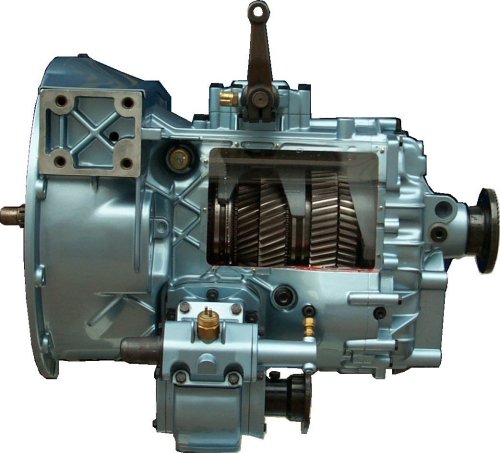
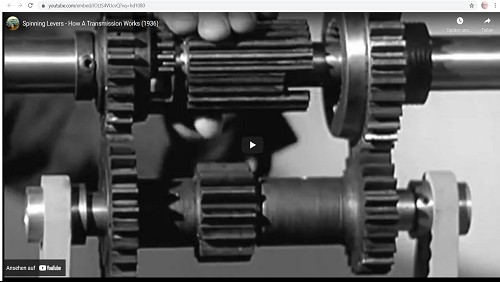
If the gears are constantly in use across their entire width, they are usually helical (picture above). If a connection between two gears is disconnected and another connection is only then closed, a clutch is required that
interrupts the traction force at least until a positive connection is reestablished in the transmission. A distinction can be made here between the initial engagement of a gear when starting off and gear changes.
A larger clutch is required for starting than for shifting gears. When activated by the driver, both functions are combined in the larger of the two. A semi-automatic transmission does not have a clutch pedal. Here, the smaller
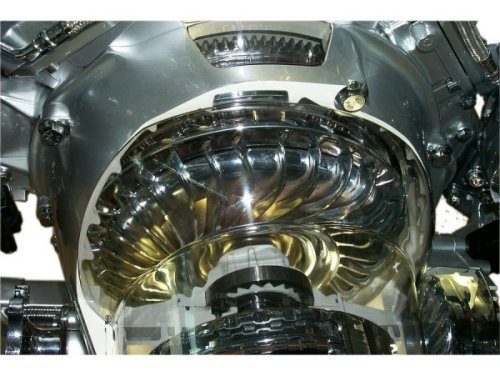
clutch is operated by moving the shift lever. In larger engines, this can be achieved by centrifugal force, or it can be replaced by an automatic clutch or torque converter (see image below)..
kfz-tech.de/PGt9
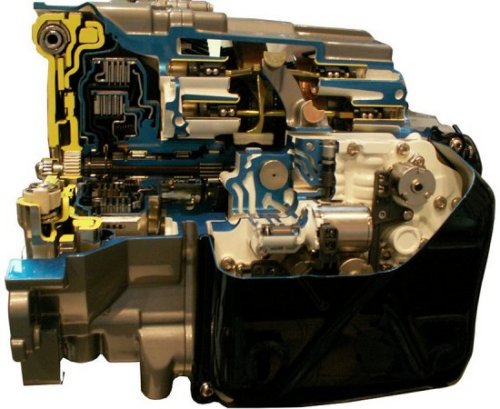
A manual transmission can be fully automated by having all functions performed by electric, pneumatic, or hydraulic actuators (image below). Then again, the one large clutch is required, through the most sensitive
actuator. If it keeps the clutch disengaged long enough, two others can select the gear in the correct gear lane. In most cases, a noticeable interruption in traction force can be felt here.
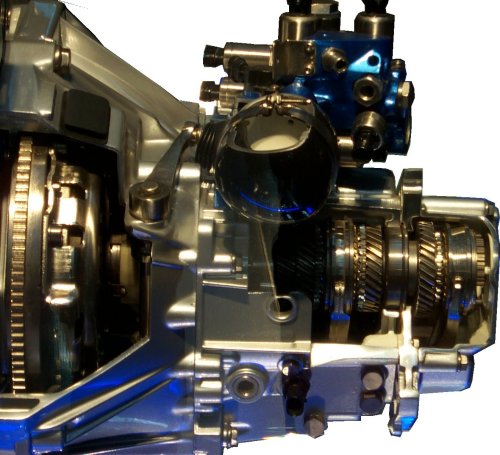
This can be avoided by dividing the transmission so that there is one clutch for each half (see image below). When one is closed, the transmission part of the other prepares the next gear. When switching between the two
clutches, there is a certain amount of overlap during which both clutches have not completely disengaged or engaged. This is referred to as switching without interrupting traction.
kfz-tech.de/PGt10
That was the direct manual or dual-clutch transmission. When starting off quickly, it can be easily distinguished from the sequential transmission described above. The latter clearly belongs
to the automated manual transmissions, while the former is not so clear, as it is quite difficult to distinguish it from a true fully automatic transmission just by listening.
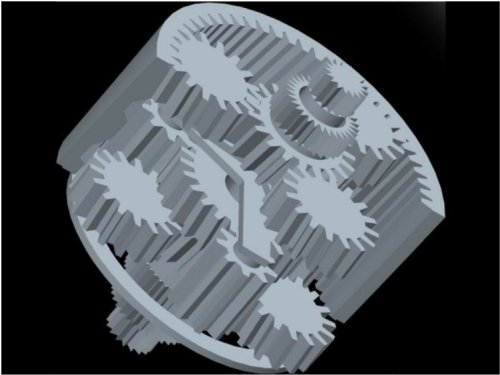
First of all, these always require an automatic clutch or a torque converter. The classic stepped automatic transmission includes at least one planetary gear set, i.e., a sun gear with external teeth in the center and a much
larger ring gear with internal teeth around it. In between, there are usually three or even four planetary gears with external teeth, which are in positive contact with both the sun gear and the ring gear.
The axles of the three or four wheels are connected as a rotating planetary gear carrier. This, the sun gear, and the ring gear can be braked individually or connected to each other. This alone can already result in three
usable gears and one neutral gear. Several in a row (picture below), also as partial sets, now result in up to ten forward gears and one reverse gear. Shifting is done exclusively by opening and closing the connecting
clutches.
This type of transmission also shifts without traction because the clutch of the old gear overlaps with that of the new gear in its operation. However, the converter can be recognized when starting up by the typical advance of
the engine speed compared to the increase in speed. Recently, however, the converter can also be replaced, for example, by a multi-disc clutch to make room for an electric drive.
kfz-tech.de/PGt11
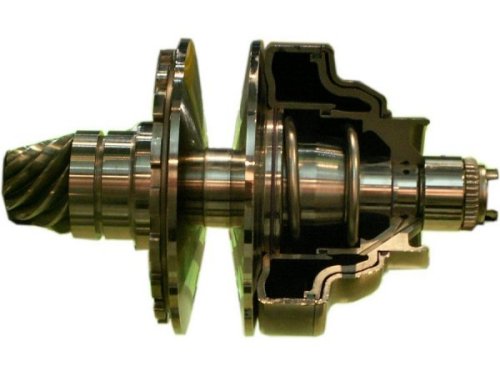
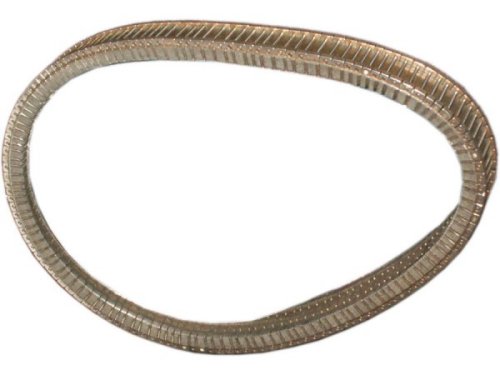
A CVT transmission can shift gears without steps and thus along the ideal traction line. Here, the force flow is essentially directed via two pulleys whose effective diameter can be changed. These used to be connected by
belt drives, but today they are connected by interlocking metal chain links. The disc wheels can also consist of two bevel gear halves (picture above), with variable spacing between them. If one effective diameter increases,
the other must decrease.
kfz-tech.de/PGt12
Of course, power transmission with variable transmission is possible in many other ways, e.g., through hydraulics, whose pressure is generated at one end of the line and tapped in a variable manner at the other end. The
cable can also be omitted entirely. One example would be the torque converter (image below), which could also be referred to as the input gear. With a overrunning clutch, it would even have two gears.
kfz-tech.de/YGt33
|