History - Étienne Lenoir History - Étienne Lenoir
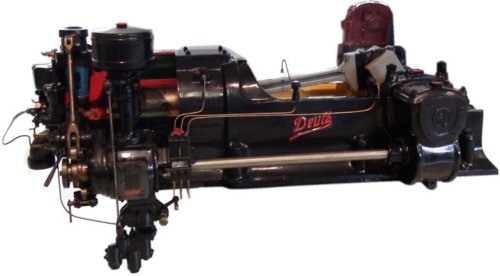
Jean-Joseph Étienne Lenoir was born in Luxembourg in 1822. At the time of his invention, he lived in Paris and worked as a waiter. He is said to have done the most diverse inventions, for which there are also
patents. Probably the most famous is undoubtedly his internal combustion engine, which he had produced in numbers of several hundred according to his plans and which also found his customers.
The patent dates from 1860 and the prerequisite for this was the network, e.g. for the gas lamps. The root idea was based on the steam engine, which was to be made usable in a much simplified form also for
smaller commercial enterprises. An important element that was missing was the boiler, which was started up and monitored by a suitably trained person well before the system was used.
Accidents with too much boiler pressure were by no means rare and caused great damage. All of this was omitted with the Lenoir engine because the combustion was relocated to the same cylinder from which
the power came to the crankshaft. Instead of a chimney, all that was needed was an exhaust pipe to the outside.
Let's try a simple explanation of the engine. So there is a piston that performs its strokes in a cylinder and whose connecting rod is connected to the crankshaft. Let us first only look at the top of the piston,
because the intake and working stroke are one behind the other in one stroke. One could say that the piston sucks in during the first half of its way to BDC and burns this mixture during the second half.
In addition, each one duct with air and one with gas flows still above from TDC, which are brought together and connected to the cylinder when a flat slide opens them. For safety reasons, air and luminous gas
remain separate until shortly before they are sucked in. The flat slide is controlled by a rod through an eccentric on the crankshaft.
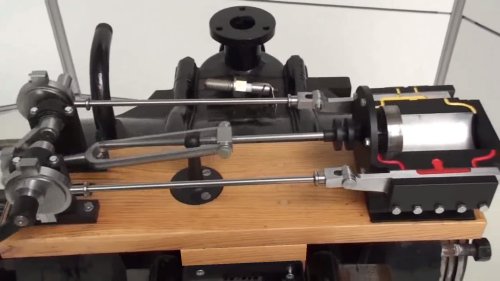
The slider for the outlet on the other side works in the same way. Only that the is open during the whole stroke back to TDC, the one on the inlet side, of course, only during the first half. But that's not enough,
because there is an inlet and an outlet for the underside of the piston, so that a (half) working cycle takes place from TDC to BDC and from BDC to TDC.
Of course, the side of the cylinder to the crankshaft as well as the cylinder head must be sealed. That is why the connecting rod is divided into a bar that always moves in a straight line and one that works
together with the crankshaft, as we are still used to with today's internal combustion engines. But there were and still are many other motors that work with such constructions called 'crossheads'.
Oh yes, since, in contrast to the steam engine, the combustion took place in the working cylinder for the first time, it had to be naturally cooled, and that was particularly strong because of the double-sided
combustion. While the working cycle, which was only half a stroke, was rather disadvantageous, the Lenoir engine shone with induction ignition, distributor and spark plugs.
Since it was almost always a stationary engine, the induction apparatus or the ignition coil, as we say today, could be connected to a power supply or, in view of the year, to a battery. The manifold consisted of
a slide isolated from the rest of the machine and attached to the crosshead.
The slide performed the linear movement of the stroke and was able to guide the long bar connected to the ignition coil in the first half of the piston travel from TDC to BDC with the spark plug to the space below
the piston and in the second half to the spark plug responsible for the space above the piston.
One could even speak of a multiple ignition in each case as long as the piston was in the respective half of the stroke. The spark plugs already had a porcelain insulation, which, however, was pervaded by two
wires. Overall, the working method of the Lenoir engine was comparable to that of an atmospheric two-stroke engine with valves.
Of course, the efficiency was very limited, e.g. significantly higher than Lenoir predicted. The machine may also have developed a certain sound level due to the throttle in the middle of the stroke. For the
durability of the crankshaft, however, this was more favorable than if it would be done in TDC.
The resulting pressure was simply not used for long enough. At first, the gas supply was also controlled by hand, until speed regulators were used, as they were known from steam engines. Its fame is justified,
as it was the first internal combustion engine to be produced in large series. There had even been attempts with the engine in a vehicle and boats.

kfz-tech.de/YGe4
|