Emil Jellinek Emil Jellinek
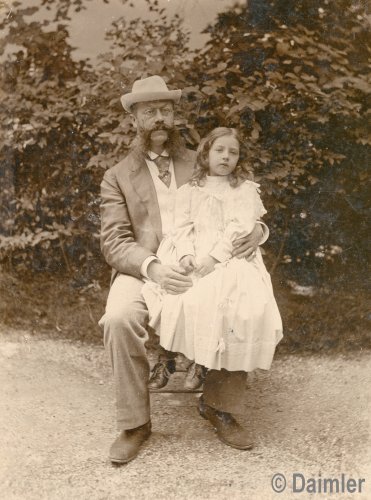
A father with his daughter, what can this idyll have to do with the history of the automobile? And both should have a part in it. Once we reveal the first name of the only daughter from his first marriage, who was six at the time,
the riddle is almost solved: Mercédès. Actually, the vehicles from Daimler should also identify themselves with the correctly spelled name.
Incidentally, pronunciation in real Spanish is even more difficult for German tongues. The father loved it, the language, even though he was born in Leipzig in 1853. And the French language anyway, after all, a main part of the
story to be told here takes place on the Côte d'Azur, part of the French Mediterranean coast. In the end, everything at least bore the byname Mercedes, the cars, the newly founded company, the villas and also the family, which
was expressly confirmed by the authorities in Austria in 1903.
So Nice was only the winter residence at the time, with a second villa later joining the one. As you can see, Jellinek has become very rich over the course of history. But his real home was Vienna, where he lived as the son of
a chief rabbi whose area of activity had changed from Leipzig to Vienna. One brother later became a lawyer and a world-renowned expert on constitutional law, the other a professor of ancient German studies.
kfz-tech.de/PGe27
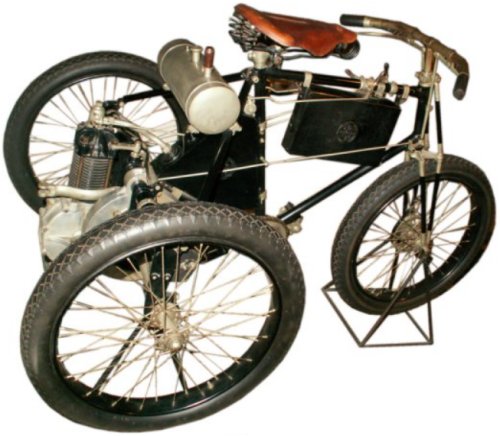
Emil Jellinek was apparently more interested in technology, became an official at the Austrian Northwest Railway and initially emulated his uncle, who had a railway company. He financed his automobiles through successful
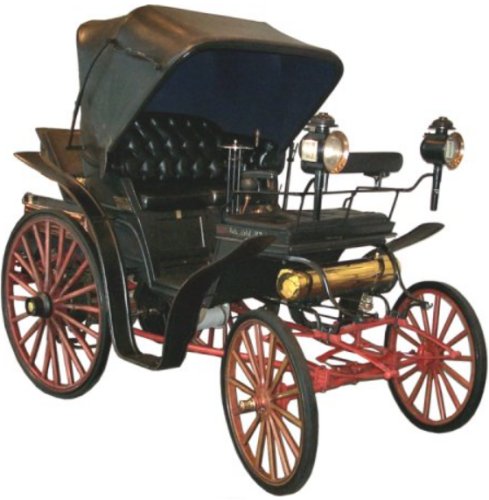
insurance and share deals. It all started with Léon Bollée's steam-powered tricycle and Dion-Bouton's internal combustion engine (pictured above). After all, among his vehicles was a Benz Victoria, built from 1893 (picture
below).
| First four-wheel Benz . . . |
kfz-tech.de/PGe28
The next car purchase, because up to then nobody had satisfied him, was to have a fateful significance for him. It was a Panhard & Levassor with a two-cylinder and 2 kW (2.5 hp) output, which was based on a license
agreement with Daimler-Motoren-Gesellschaft. And while searching for the origin of this engine, Jellinek met Wilhelm Maybach in Stuttgart in 1897.
There was probably already a version of the engine with 4.5 kW (6 hp), in any case at least one of the two newly ordered cars was equipped with this engine and Jellinek enjoyed a top speed of 40 km/h and coping with 12
percent gradients, despite the still difficult driving characteristics. He accepted the fact that he has to find and refill a good 50 liters of water per hour to do this.
After all, good basis awaited him in the car and a certain operational reliability that had been missing until then. The next year he bought 3 and in the two years thereafter 10, respectively 28 cars directly from Daimler, which
then accounted for almost a third of the total production. This finally gave the company a market power that went beyond that of the Benz company, which had sold significantly more up to then.
1900 was also the year of Gottlieb Daimler's death, which gave Maybach significantly more freedom of choice for the next seven years. He agreed to Jellinek's initiative, to take part in races to convince his discerning clientele,
to whom he retails the cars. It got even crazier when, for example, Jellinek demanded 17.5 kW (24 hp) and Maybach even supplied 25.5 kW (35 hp) in 1901.
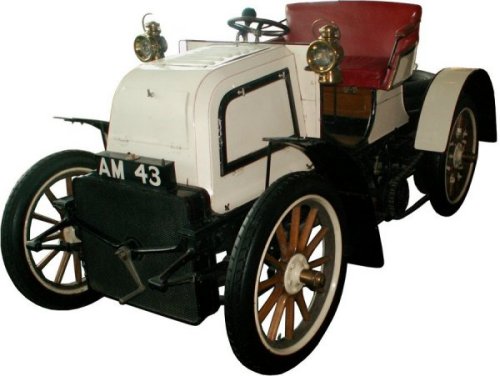
| Racing car from 1900 with 17 kW (23 hp) . . . |
kfz-tech.de/PGe95
So it was hardly surprising that Mercedes, as the company was now called, won the Nice-La Turbie race in 1991. This very early design of a four-cylinder in-line engine showed how far Maybach was ahead of its time, albeit
divided into two blocks, as was common practice for a long time.
In accordance with the time, it was designed with a long stroke, had almost six liters of displacement per cylinder and vertical valves operated on both sides by a single lateral camshaft. These could be dismantled or
processed through closable openings, although the cylinder heads were cast together with the cylinders.
The combustion is initiated by a breakaway ignition with an adjustable ignition point, although the rated speed is 'only' 1000 rpm. Even the previous model shows the famous honeycomb cooler that limits the enormous water
consumption and a chain-driven transmission instead of a belt drive.
| The honeycomb cooler significantly reduces the amount and thus the weight of circulating water
compared to the small tube cooler. |
How important the new intermediary Jellinek had become for the company was shown not only by the name change, but also by the fact that Maybach appeared in Nice before the race and was able to rectify a few
shortcomings. The car then not only achieved victory, but also a top speed of 80 km/h.
|