History - Steam Cars History - Steam Cars
When you say 'steam', you usually mean 'water steam', although this can actually mean a gaseous state for almost any element. So there is no essential difference between a gaseous and a vaporous state. However,
we are indeed dealing with water vapour here.
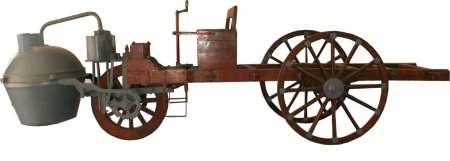
A steam engine in this sense differs from a combustion engine mainly in the spatial separation of the heat generation from the pressure transfer to a type of gear or directly to the wheels. The example of Nicolas
Joseph Cugnot's from the year 1765 shown here was probably one of the first steam-powered vehicles and is a good illustration of this.
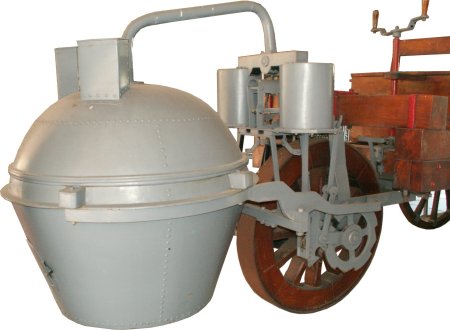
In contrast to the first Cugnot model, this one weighs four tons and carries the boiler, which is used for the combustion and heating of water, in front of it. By the way, this has a second disadvantage, namely the long
heating up of a steam engine. Direct starting, impossible. Towards the end of development, however, there were vehicles with a small steam supply for starting in less than a minute.
Mind you, this is a design that came into being just before the significant improvement of the steam engine that James Watt made famous. The spatial separation of combustion chamber and power transmission also
has an effect on efficiency. The diesel engine, for example, achieved four times the efficiency even at an early stage. But after all, the steam can also be used for other things on its way, e.g. for the bell pipe on the
railway.
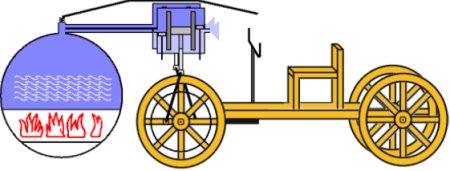
Actually, the combustion engine and the steam engine have the crank drive in common, but here we are dealing with a kind of freewheel. The force only acts on the front wheel when the piston on each side is moved
upwards. While it comes back, the other side works. The two cylinders are thus alternately charged with steam, which can reach 80 bar and more at 1,650 times the expansion of the water that has become steam.
What Cugnot forgot, though, were the brakes. In addition it was difficult to steer due to the extreme overweight at the front. Result: A barracks wall was rammed, which meant in the demonstration for the military the end
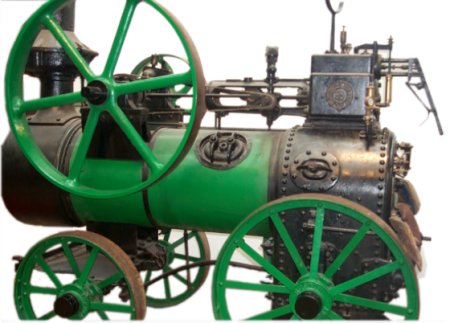
of this project. Below you can see another application of steam power, but not for locomotion, only to drive agricultural machinery.
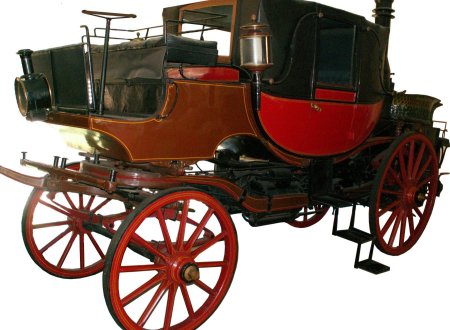
Below you can see the converted coach of Virgillo Bordino from 1854 from the museum in Turin. It was heated with coal and reached a speed of about 8 km/h. In principle, steam technology could be used well for the
first bus lines. Unfortunately, however, the high heavy vehicles with their narrow wheels proved to be unsuitable for the unpaved roads of that time, especially in winter.
You will also see a replica of a DeDion steam car from 1883 from the Technik-Museum in Berlin. DeDion was a technically interested French count. Together with the mechanic Georges Bouton, he founded one of the
oldest automobile companies in the world, soon only for vehicles with combustion engines.
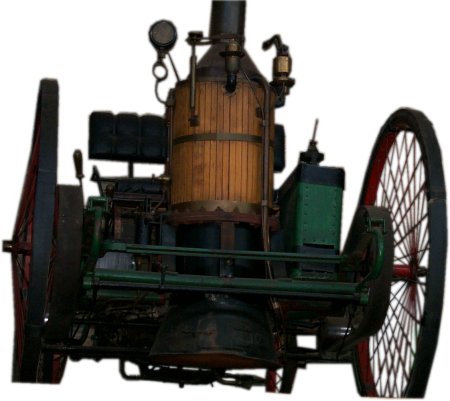
These machines do not yet pay attention to favourable efficiency. Rather, one seems to be glad that they run and make work less heavy. While solid fuel plays an important role in the railway for a long time, the steam
car is converted to liquid energy sources at an earlier stage. This is usually kerosene, but the steam engine is generally less choosy than the combustion engine.
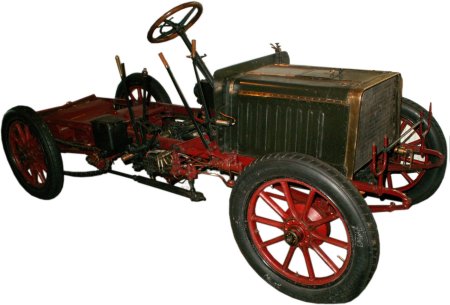
Below now follows a steam car from 1904. It uses petroleum to generate steam of similar pressure, but delivers torque to the rear wheels via four cylinders and a chain. The vehicle also has a condenser for water
recovery. It is therefore no longer necessary, for example, to refill up to 1,000 litres of water every 40 kilometres in a steam truck.
Steam cars had thus reached the peak of their development around this time. They were considered expensive, but also very reliable and quiet. While the records for cars with electric and combustion engines were
around 100 km/h, a steam car from the Stanley Motor Carriage Company achieved more than twice as much. After all, the Blitzen Benz was able to exceed this record in 1911,
.
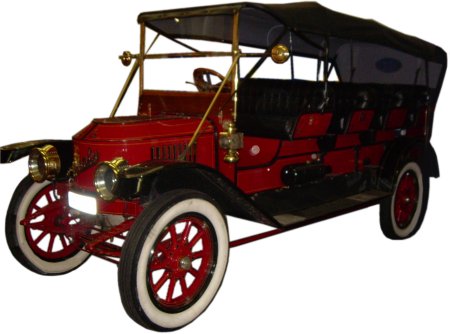
| The Stanley is regarded as the Mercedes among the steam cars.
|
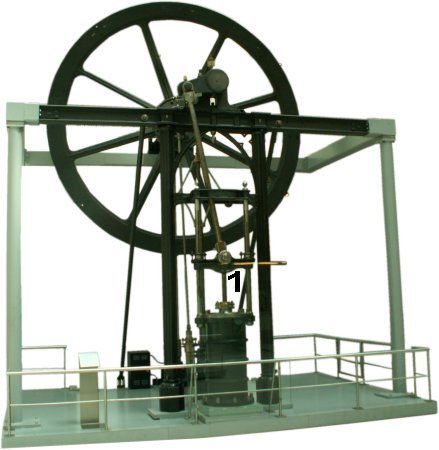
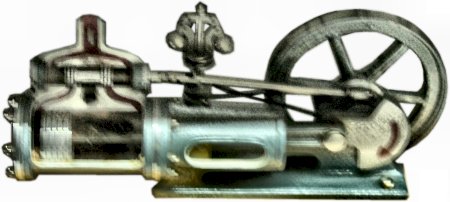
Below again a picture, which makes clear the principle of the transmission of the steam pressure on the flywheel, this time with a double-acting piston and in the middle the crosshead, which transfers the back and
forth movement of the piston on the connecting rod and thus on the crank drive. The steam enters the picture in the upper left-hand corner and is directed either to the left or to the right by the control system. In the
middle the centrifugal governor, which prevents a too high engine speed.
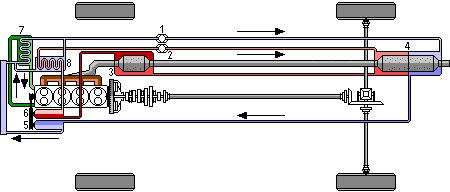
You won't believe it, but there's a reference to the present. In 2006, BMW conceived a kind of steam engine as an auxiliary unit as a way of saving CO2, which drew its heat from the exhaust tract. Probably
the expenditure was too large in relation to the efficiency. In any case, the project was put aside again.
|