Before the World War
We have already mentioned Mussolini's attack on Ethiopia, but have not yet sufficiently examined the consequences. Enormous preparations were made for this and especially for the second attack in 1936 after the failed
first.
The economy, especially the war preparations, were largely nationalized. Fiat was brought into line through subtle gestures, such as the closure of the Ford plant in Trieste. One less competitor. Fiat became the largest
company in Italy.
The breadth of Fiat's activities is incredible, with steel, aircraft, ships and submarine production. They were even involved in road construction. It is no wonder that such a protégé as Giovanni I felt compelled to join the
Fascist party in 1933.
After the global economic crisis, other connections were sought instead of the USA. The war had brought Italy the distrust of the Western world. The Western world responded with sanctions, which Hitler naturally saw as
an
opportunity to bind Italy more closely to him, especially economically.
In 1939, the so-called 'Pact of Steel' was signed, which obliged Rome and Berlin to support each other in the event of war. Following the non-aggression pact between Germany and Russia, war was imminent. Italy was
not
yet ready and only joined the war on June 10, 1940.
So the Italian industry was again called upon because Mussolini offered raw materials and finished products instead of armies. Fiat was already delivering to Germany. Overall, exports there had risen from 18 to 29
percent.
It will remain an important connection even after the war.
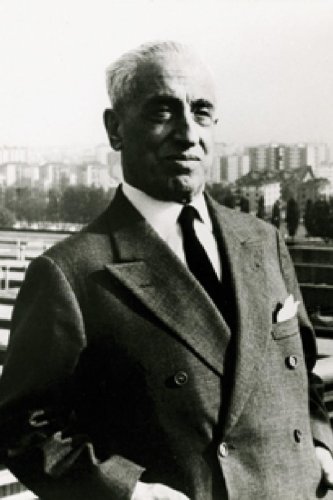
We have to stop here and talk about a second important person at Fiat besides Giovanni I. We are talking about Vittorio Valletta (pictured above), 17 years younger than Giovanni I. He came out of nowhere, so to speak, and
only stepped down in 1966 to hand over the company to Giovanni II.
Valletta was someone who worked his way up from being an accountant through school, university and experience in running companies. After founding his company, he joined Fiat at the age of 38. He was small and
ambitious. It was a slog through companies under Fiat's care.
They owned the aforementioned RIV ball bearing factory and, by then, the daily newspaper La Stampa. It soon became clear that, with his talent for administration - after all, his first company was a management
consultancy
- he would eventually take over the management. Giovanni II had the skills his grandfather had in mind for him, but was still considered too young.
Giovanni I and Valletta were in complete agreement about the authoritarian leadership of the company. Both considered themselves liberals, neither black nor red. This resulted in a very pragmatic attitude: the main thing
was that it was good for Fiat. The connection probably also has its origins in Valletta's undisguised admiration for Agnelli's achievements in building it up.
Giovanni I and Valletta were in complete agreement about the authoritarian leadership of the company. Both considered themselves liberals, neither black nor red. This resulted in a very pragmatic attitude: the main thing
was that it was good for Fiat. The connection probably also has its origins in Valletta's undisguised admiration for Agnelli's build-up power.
Of course, the enormous expansion of production could not be achieved with the one main plant in Lingotto (Turin). So in 1939 the new Mirafiori plant was built south of the city center, beyond Lingotto, and at the time it was
one million square meters in size. It consisted of two parts and a small test track.
It is still in operation today, while Lingotto has become a shopping center. There is still a design studio there, but production has been significantly scaled down after years of full capacity, which made Fiat the fifth largest
car
manufacturer in the world in 2000, for example. Stellantis is in negotiations with a Chinese manufacturer to produce its cars there.
|