Dante Giacosa 4
kfz-tech.de/YFi187
Mussolini and his vassals initially had only indirect contact with Giacosa's work, apart from a visit to the factory. Until October 1935, when Italy declared war on Ethiopia and replaced the king there with its own. Sanctions
were then imposed on Italian industry.
For example, the hydraulic braking system on the Topolino originated from Lockheed, and it was desirable anyway not to have to pay for every car delivered. During this phase he met a Mr. Baldwin. With the help of Giacosa,
it
was possible to use his patents for control of a hydraulic brake instead of the more expensive one from Lockheed.
Giacosa mentions that it would certainly have been better for the company to join the party at that time, but he does not say whether that really happened. In 1937, at the age of 32, he married. Then the wedding trip in a
Topolino. Two years later, his daughter was born.
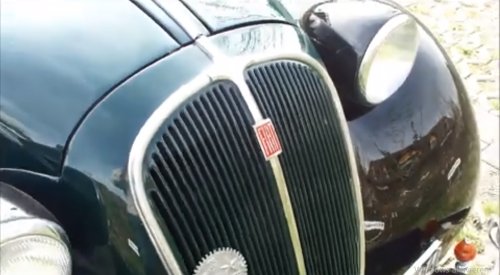
In 1937, the 508 C was introduced, also known as the 'Ballila 1100' or 'Super-Ballila'. It had an engine that had been enlarged from 995 cm3 to 1,089 cm3, and now produced 23.5 kW (32 hp) in
everyday use. As a delivery van or taxi with six seats, it was available with a lower compression ratio and 2 hp less.
It is remarkable because it ushered in the very long era of the 1100 at Fiat. Giacosa mentions a figure of 67,000 units produced with a workforce of 40,000 in the few years before the start of the war. The 508 C with the more
powerful engine set the world speed record in its category at 145 km/h.
In 1938, the first book by Dante Giacosa was published together with A. Garro under the title 'Motori endotermici', which is the more scientific term for internal combustion engines. The book is still available today and has
884 pages. Giacosa also stood in for his superior as a lecturer at the University of Applied Sciences for Automotive Engineering.
Where there is light, there is also shadow. Giacosa lost his parents within a year and Fiat lost the director of the aircraft division, Tranquillo Zerbi, unexpectedly at the age of 53, under whom Giacosa had worked so happily
for so long. His grave was decorated with a stone sculpture depicting an air-cooled radial engine.
One of these engines, with the unusually even number of 24 cylinders and counter-rotating propellers, made Zerbi and thus Fiat famous when it won the world speed record for seaplanes. On January 1, 1940, Giacosa
was
promoted to deputy head of the overall automobile department, not yet 35 years old.
One of these engines, with the unusually even number of 24 cylinders and counter-rotating propellers, made Zerbi and thus Fiat famous when it won the world speed record for seaplanes. On January 1, 1940, Giacosa
was
promoted to deputy head of the overall automobile department, not yet 35 years old.
Under his leadership, development had already begun on a replacement for the Fiat 518 C, both with six-cylinder engines and called 'Ardita'. The weaker engine had 1,650 cm3 and 40 kW (55 hp), the more
powerful 1,750 cm3 and 48 kW (65 hp). Amazing, the independent suspension on the rear axle too.
Giacosa also developed a V8 OHV with an aluminum block, possibly following in Tatra's footsteps in the rear, but installed transversely. And then they thought about a 700 as a mid-range model between the 500 and 1100.
All of these were probably more or less studies, but you start to wonder what, except the front-wheel drive, was not developed at Fiat.
In a short intermezzo, the reasons why Fiat's upper-class models cannot compete with American ones in terms of weight were discussed; it was discovered that Fiat's upper-class models were built according to the same
standards as the vehicles in the lower classes.
This revealed the difficult road conditions in Italy, with their extremely winding roads and very different quality, the frequently usual overloading of vehicles, a comparatively large area of ??operation, the unpretentious driving
behavior and the restriction of engine size enforced by taxes on (often low-octane) gasoline.
|