|
 Ferrari - Maserati Ferrari - Maserati

At some point Maserati must appear in this book, even sooner than, for example, the Lamborghini company. In contrast to this and the Ferrari company, Maserati is actually the much more typical Italian company. Because it
was founded in 1914, it is much older than both of them. Nor has it ever been under American command like Lamborghini. However, as I said, since it has been around for much longer, the company has experienced even
more ups and downs than Ferrari and Lamborghini.
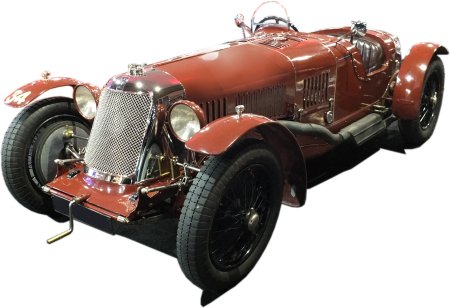
| 1930 Maserati 26 M Sport (Front view) |
Only in the modern era under the roof of Fiat with engines from Ferrari did the company come to some degree of calm. Above in the picture you can see the Tipo 26B from 1927, the further development of the first racing car
from 1926. It was intended for the Diatto brand, but Alfieri Maserati was allowed to use it for his own brand after the contractual relationship ended and a year before production there was discontinued.
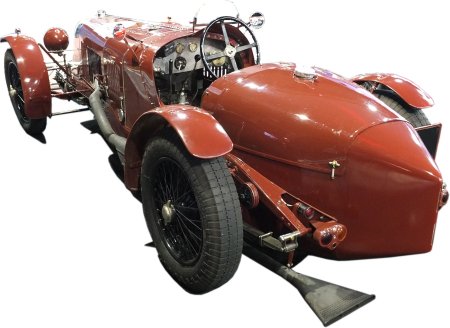
| 1930 Maserati 26 M Sport (Rear view) |
Alfieri was arguably the most important of the Maserati brothers who became relevant to automotive development. One died in childbirth and one became an artist. Unfortunately, only three of the remaining five technically
interested brothers really remained. Carlo died in 1910 before the company was founded. One started in 1914 with the production of spark plugs, maintenance and sales as an unbranded workshop and always with an
affinity for racing.
And that was exactly where the connection or rivalry to Ferrari lay. Because he had only lasted three years of abstinence. The tasks as an independent brand dealer were probably not satisfactory for him. Since 1927 he was
racing again, with the older RLSS he achieved a class win in Alessandria, 200 km to the west, and with the newer 6c in Modena itself. In 1928 he repeated both and also took third place in Mugello. Something had to happen
to finally dissuade Ferrari from racing and that will happen . . .
His participation as an organizer in racing he did not give up until the end of his life. At the end of 1929 he took an important step towards this, namely the founding of Scuderia Ferrari, for which he won financially strong
partners from business life, and later even from the nobility. The aim was to buy racing cars, of course Alfas on favorable terms, and to successfully participate in racing events. Furthermore, the care of customer vehicles.
And right here the sporting conflict with Maserati was preprogrammed. The small company Maserati acted, depending on the race participation, against the Ferrari company, which was also still under construction. The five
Maserati brothers from Bologna had meanwhile clearly established themselves as manufacturers of racing vehicles under the leadership of Alfieri. Proof could be those sixteen-cylinder above. If you don't want to believe the
enormous number of cylinders, take a look at the picture below, there are two eight-cylinder exhaust manifolds to be seen one behind the other.
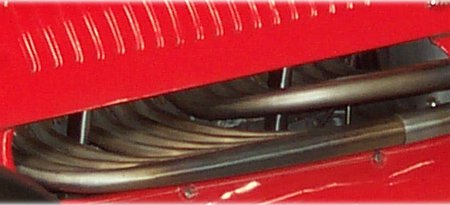
Even before Ferrari was founded, one was able to achieve the average speed of almost 250 km/h, which was legendary for the time, over a distance of 10 km. In Italy one got rid of all competitors. Fiat was out and Isotta
Fraschini already for a long time, Alfa ally. Now there was a new competitor in the fight for the top drivers and the considerable sponsorship money. Fortunately for Ferrari, the situation at Maserati was difficult because the
brothers seem to have more difficulties with finances than with racing engines.
| Even Fritz Opel's 'rocket car' was slower. |
Like for a long time at Alfa, they took part in races fairly regularly and also sold cars to customers. However, Alfieri Maserati died as a result of an earlier racing accident in 1932 and, under the leadership of Bindo and Ettore,
the momentum waned. In 1937 the company was sold to the industrialist Adolfo Orsi, however, the technical management one retained. Now it got really uncomfortable for Enzo Ferrari, because the company is being
relocated from Bologna to Modena, the headquarters of Orsi.
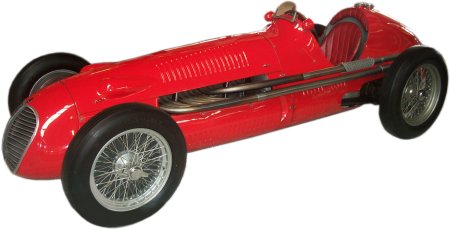
Now the competitor's racing cars drove vociferous past his house during test drives. To get a dimension from the competition, one only needs to take the results of the Targa Florio. In 1930/31 the Alfa factory team won with
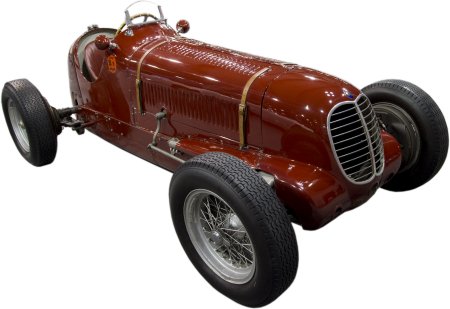
respectively Varzi and Nuvolari. For the next four years the Scuderia took over the victories, but was replaced in the next four years by Maserati with the famous 6CM (picture below).
|
|