|
 Transistor 1 Transistor 1
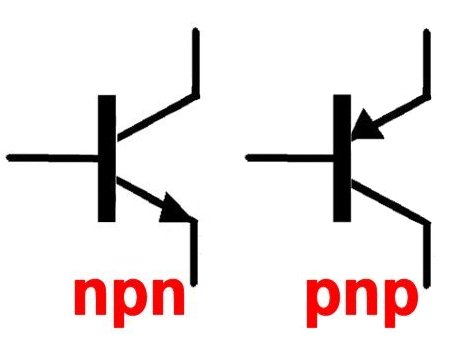
The transistor is a typical electronic component. In fact, it even established electronics. This is divided into the analog technology that has existed already for some time and the somewhat newer digital technology. As a
component, the transistor is represented in both. In analog technology it is also used more frequently as an amplifier, e.g. in transistor radios. However, it is particularly important for digital technology, where it works much
more frequently and as a switch.
| Very rare here: components with individual transistors. |
Compared to the working current relay, the transistor is not only much faster, it also has an almost unlimited service life - properly fitted into the circuit. Unfortunately, in relation to the load to be switched, its efficiency is lower,
which can often be seen in the higher heat development and the heat sinks that are often necessary as a result. It is also important that a transistor, in contrast to a relay, does not enable perfect galvanic isolation between
the working and control circuits.
A semiconductor usually consists of a single crystal, usually silicon or, much more rarely, germanium. The crystal contains at least two zones of different conductivity, so it can be compared as merging of two diodes. The
crystal contains at least two zones of different conductivity, so it can be compared as a union of two diodes. No, you can't make a transistor out of two diodes. If we coupled the two together on their n-sides, we would have the
layers p, n, and p , but we wouldn't get a p-n-p transistor because at the n-layer would be missing the base connection.
Conversely, one could combine two diodes to form the layers n, p and again n, but here too the missing base connection at the p-layer would prevent this structure from being called an n-p-n transistor. And if the p-layer
became the base, it would have to be very narrow and at the same time particularly lightly doped. In contrast, the emitter below in the left picture is very heavily doped. It is called that because it has plenty of electrons available
and can bring them into the circuit.
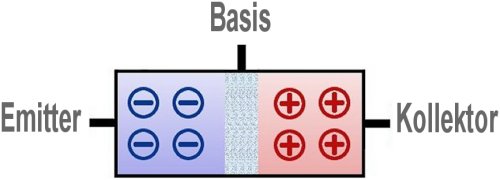
The lattice structure and thus the conductivity is influenced differently by the addition of certain metals (e.g. arsenic, antimony) in the layers. If you now start from the model with the two reversely connected diodes, then a
current flow between the emitter on the left and the collector on the right is in no case possible, regardless of whether you apply negative on the left and posirive on the right or vice versa. In the first case, the collector side
blocks, in the second case the emitter side.
| The transistor only reacts to a base voltage of 0.6-0.7 volts. |
Simultaneously what has been said here also applies to the p-n-p transistor. Whenever a voltage is applied in the sense of the middle letter for the base, a current flows between collector and emitter. Compared to that
between collector and base, an amplification of up to a factor of 1,000 and more is possible. The term "transistor" was thus created as an artificial word from "transfer resistor", which indicates the transfer of resistance
changes in the boundary layers.
The solution is to put a positive on the base in addition to the negative on the left and the positive on the right, then the collector side is bypassed first. So a current flows between the emitter and the base. The many electrons
also reach the collector area and a kind of channel for the current flow is created there as well. The current between emitter and collector also changes depending on the strength of the base control. This phenomenon is
called amplification of the emitter-base current.
Because of the possible involvement of electrons and their legacy, the holes, this transistor is given the prefix 'bipolar', in contrast to a field effect transistor. Both types can be used for amplification, but also as a switch
through a strong change in the control voltage, typical for digital electronics.
|
|