|
 Records Records
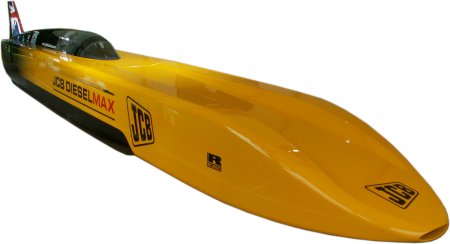
This vehicle made automotive history for Great Britain, the first time in 2006 when it reached 529 km/h on the famous Bonneville Salt Flats. Two facts proved that it could do even more: firstly, it reached 'only'
521 km/h on the outward journey compared to 536 km/h on the return journey. The driver, Andy Green, also later admitted that he had only used five of the six possible gears.
The collaboration between JCB and Richardo probably dated back to 2004, when the company had decided to build the diesel engines for its own construction machines in a completely new factory. The JCB
444 was an engine designed for large front loaders, 6 cylinders in line with a turbocharger and side camshaft, four valves operated by pushrods and fork connecting rods.
There was probably already a plan to upgrade this engine back then. The British company Richardo was represented worldwide and was famous for its traditional engine know-how, among other things. It was
founded in 1915 by Harry Richardo. In addition to his studies in Cambridge, he already had a lot of experience with the design of combustion engines. The first major task was to make the engine of the Mark V
tank somewhat smoke-free, which was not entirely unimportant for strategic reasons in the raging First World War.
An engine with antedated squish edges and one with variable compression from 1919 clearly stand out from Richardo's other innovations. Both were intended for petrol engines, but perhaps also paved the way
for a certain level of competence for diesel engines, which was demonstrated, for example, in the swirl chamber known as the 'Comet' from 1931.
One direction of product expansion concerned the further path of the torque in the vehicle. Strangely enough, Richardo claimed the viscous coupling for itself, although the German Mahle-Behr Group did the
same. They have worked on famous vehicles, such as the US military's FED Alpha, the almost unbeatable Lancia Delta and, last but not least, even the Bugatti Veron and McLaren M838T. At Bugatti, they
were involved in the dual-clutch transmission, while at McLaren they were involved in the engine.
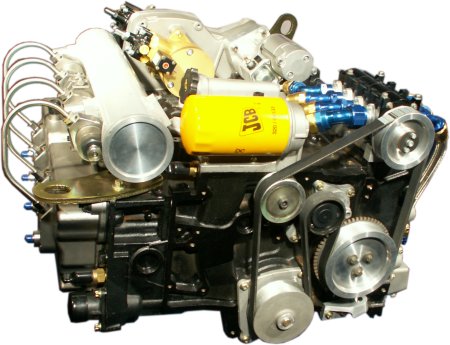
Admittedly, the record for supercharged petrol engines was already beyond the capabilities of the two former excavator engines, each of which had been boosted from 103 kW (140 hp) to 551 kW (750 hp). In
contrast, the diesel engine's record was 235 m/h, i.e. 'only' 376 km/h. Incidentally, no starting and acceleration process was planned from the outset, which would have put excessive strain on the clutch, for
example. The car, known as the 'cigar', was pushed to 50 km/h by a construction machine with an essentially identical engine.
The vehicle, which was nine meters long and weighed around 2.7 tons, had a carbon skin on the outside and, in addition to the two engines, a 180-liter tank on the inside. This tank was not filled with diesel
fuel, but with ice cubes. The heat of vaporization provided an additional cooling effect. The high weight showed that it was detrimental to good acceleration, but not to this enormous top speed.
As already mentioned above, ten years later they competed again in Bonneville with a team of over 30 and raised the record to 563 km/h.
kfz-tech.de/YDM28
kfz-tech.de/YDM30
|
|