Transparancy Transparancy
kfz-tech.de/PBe27
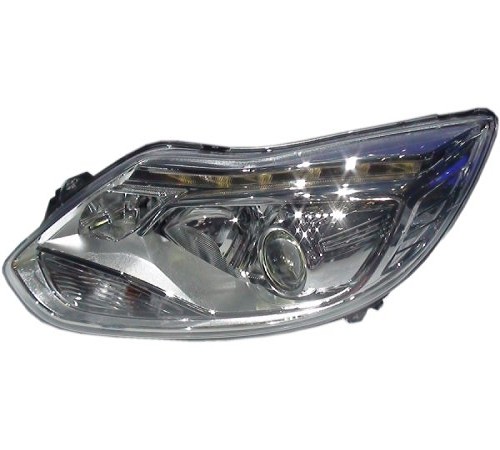
Headlights are often referred to as the eyes of the car. If you don't think that's an exaggeration, then consider a comparison of a particularly appealing inner life with the particularly beautiful
eyes of a human being. You can hardly concentrate on the conversation; you keep having to look into those eyes, especially since that's not at all inappropriate, for example, in the case of a woman, right?
kfz-tech.de/PBe28
Regardless, we are concerned here with the production and possible repair of such a component, which in some cases can expand into a monstrous size. Final remark: The fascination of headlights certainly influences
buyer behavior. The invention of the transparent window in front of the reflector(s) or lens(es) has played a major role in this development. So let's start with that.
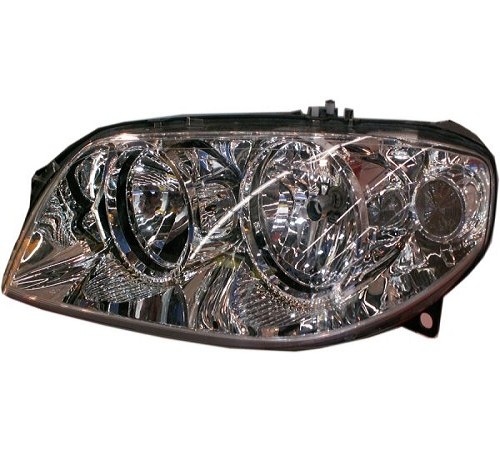
Whereas glass for transparency and metal for casings used to dominate here, today it is highly durable plastics, creatively designed in a variety of shapes. Most are produced using the
injection die molding process. The starting material is usually granulate, which is heated to form a viscous mass that is pressed into a mold. This is how both the housing and the end plate are created.
kfz-tech.de/PBe29
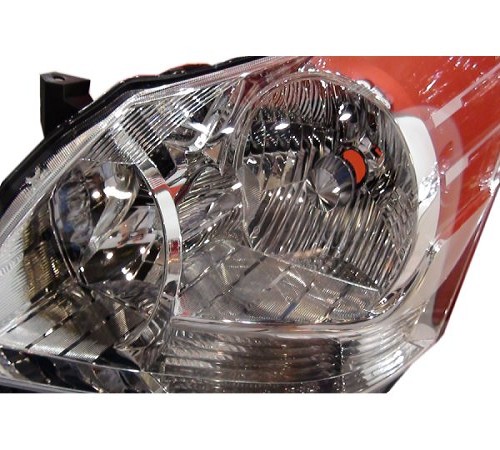
The latter are available with or without scattering optics. Both may also be combined on the rear window. Polycarbonate is considered the material for screening. One gets the feeling that, over the years since the at least
partial move away from glass, it has become increasingly resistant to scratches, but also to friction particles in the air, e.g., when driving fast on the highway.
The development of special coatings, some of which are even standardized in regulations, certainly helps here. Of course, moving away from glass has not only resulted in greater design freedom, but also reduced weight.
When the cover lens comes out of the injection die molding machine, it can be wiped with an antistatic cloth and cleaned with compressed air shortly before further assembly to remove any dust.
kfz-tech.de/PBe30
Incidentally, the coating also helps to prevent the yellowing that is so often observed, mainly caused by ultraviolet radiation. After coating, another pass through the drying oven is required. The housing can also serve as a
reflector. It is made of fiberglass. It becomes a reflector through the application of a primer and the vapor deposition of aluminum.
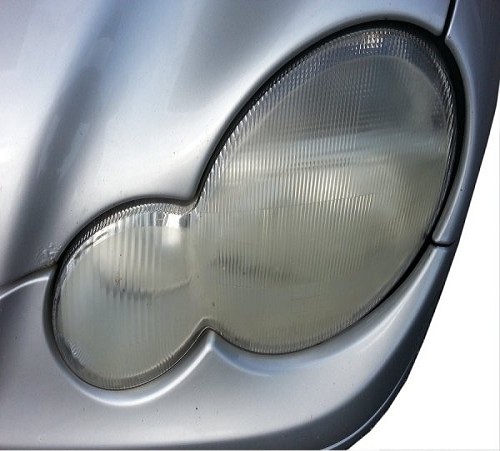
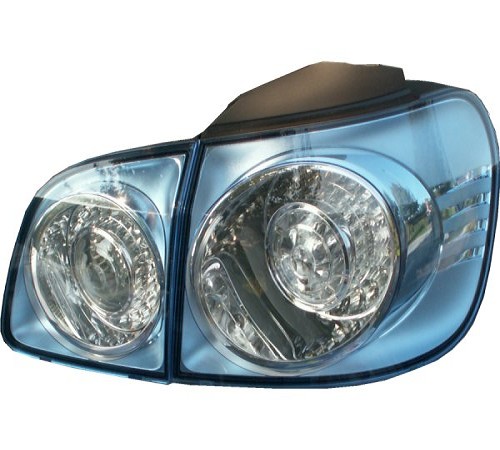
At the top of the picture, we have such a case. It is unlikely that any light will penetrate these end plates. As always, there are basically two solutions to the problem: replacement or repair. Given the prices, the latter is very
popular. But one thing must be clear: even with the most successful repair, they will never be as transparent as they are when new.
kfz-tech.de/PBe31
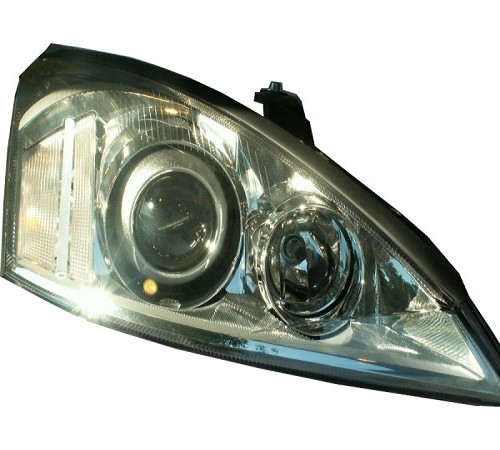
After all, if this is carried out reasonably, then passing the next general inspection will be no problem. Before you start, you should be more concerned about the surroundings than the headlights themselves. This is
because treatment with sandpaper (<1/1000 mm) or a suitable polishing paste will be necessary, and the lacquer should be spared this if possible.
Masking tape is only half the solution, unless you do all the work very carefully by hand. But if you use a machine, you can quickly lose your way. Therefore, our advice is to remove the headlights, even if you need
instructions to do so in many cases. Even removing it is not always easy these days and can even cause nasty scratches to the plexiglass of the deck surface, including the breakage of plastic parts.
kfz-tech.de/PBe32
This means that the repair process should be clearly defined. All that remains is to reapply the coating at the end and adjust the light after installation. Further dismantling is not recommended. At most, if
the cover glasses are available individually. In any case, dismantling requires a lot of intuition and a oven set to, say, 80°C.
They keep trying to see if the headlight can be opened at the adhesive joints without anything breaking off (= disaster). And if that doesn't work, put it back in the oven. It is even more difficult to
regain its tightness. Some people leave the adhesive (primer) on and also use the heating method during assembly.
kfz-tech.de/PBe33
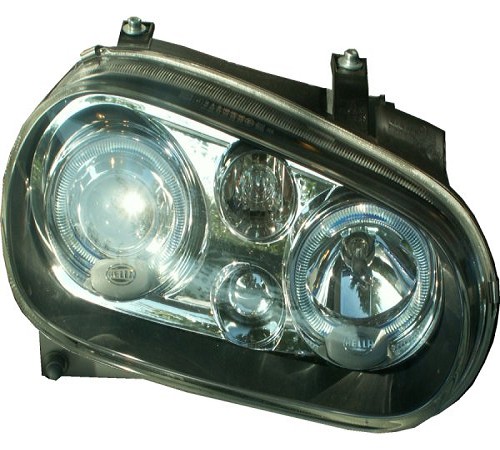
| Older headlights are also available with clamps instead of adhesive. |
You can tell that it doesn't sound very professional. Actually, there is no reason for these measures. Unless the lens is affected from the inside or the reflector has been exposed to excessive heat in one spot, e.g., due to a
defective bulb. But will you be able to repair it properly after opening it?
When installing new parts, you 'only' need to remove the adhesive from the rear housing. But how good are you at distributing the new? Or does it swell up during assembly into the area visible from the outside
and ruin the image of a successful repair? Sie merken schon, wir würden einen geklebten Scheinwerfer nicht öffnen.

kfz-tech.de/YBe23
The situation is quite different with a classic car. For those who cannot see the video, here is a brief description. In it, the owner of a 1935 Cadillac has the problem of not being able to get headlight lenses. At least he can
borrow one, and now it's a matter of making a plexiglass impression from it.
First, he mixes together two components that will later be used to shape the exterior. All air pockets are removed from the silicone in a vacuum chamber. Then the original is placed in a container that fits as well as
possible and is poured over until it is no longer visible. After drying and applying a release agent, the other side is also cast.
Once the silicone has dried on this side too, one removes the surrounding container and carefully open the mold at the dividing line to release the original. The plastic that is to replace it also must be mixed accordingly.
Rest and processing times must be observed again. Here, it is even more important to avoid air pockets.
The result is certainly impressive. It is quite possible that without touching them, you would not even notice that these headlight covers are not made of glass, regardless of whether they are diffuser lenses or not. However,
before you dive into the work and expenses, you should clarify the whole matter with the relevant TÜV (Technical Inspection Agency). Newer headlights all have an E number, which is likely to make approval significantly
more difficult.
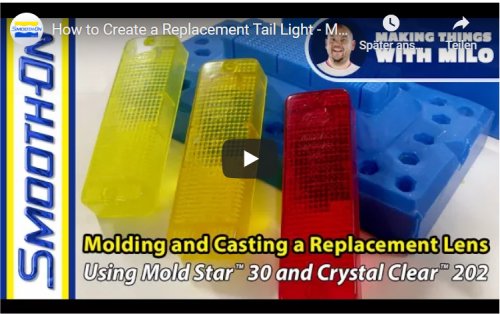
If you still haven't had enough of DIY with all its risks, you can even make colored covers, e.g., for turn signals. This is explained in the video below, along with vacuum sealing, even
in more detail than in the video above. Our references to the TÜV survey and test number remain valid in this case as well.
kfz-tech.de/YBe22
|