With control 1 With control 1

Thermally highly stressed wastegate flap integrated directly into the turbine housing
So, now it is time to come to the really infinitely widespread control of the turbocharger. It is called 'wastegate', which loosely translated means 'exit for what is not required'. This term describes the function quite aptly. A lot of
exhaust gas arrives at the turbine wheel with perhaps high pressure and some of it is better not to be used.
We are now assuming an operating range in which the engine is operated at the maximum possible pressure and an even higher pressure would be harmful to both the engine and perhaps also to the turbocharger. What to
do with that too much exhaust gas/pressure? A clear case, you open a valve and a certain amount is allowed to flow directly into the exhaust system. The wastegate principle is still the most widely used today.
Wastegate limits the maximum possible boost pressure.
However, there is a control mechanism behind it and that has already changed fundamentally. You can guess what it looked like before. A maximum pressure was simply specified with which the engine could be
pressurized. It was fed into a kind of barometer box (picture below), which opened the wastegate valve when it was exceeded. Here, too, it was a matter of control, because if too much exhaust gas rushes through the bypass,
the boost pressure drops and the valve is closed again.
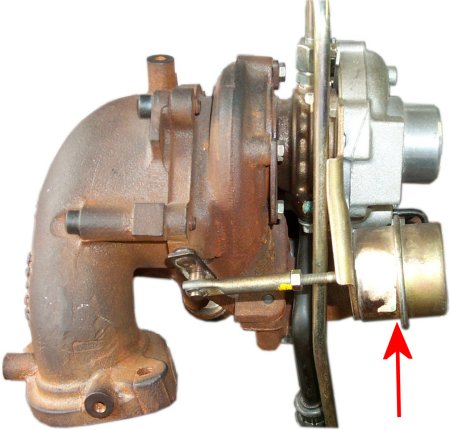
At the top of the picture you can see such a valve in the exhaust-side part of a turbocharger. Via a rod-shaped connection, it can either lead to a pressure cell with a membrane and pneumatic control or to an electric
servomotor. Both are placed at a certain distance from the valve itself, because the heat generated there can be so great that it even burns red. The parts of the regulation would not be able to withstand that.
Modern turbochargers are designed for a very specific, maximized boost pressure. One tries to limit oneself in size, not only because of the housing, but especially because of the rotating parts. The lighter they are, the faster
they will restart, e.g. after a boost phase. In a gasoline engine, for example, the throttle valve is closed and this naturally slows the speed of the compressor wheel and turbine wheel. Delayed restarts lead to the well-known
turbo lag.
A distinction is made between internal (top picture) and external waste gates. The latter are arranged a little further away from the turbine on the pressure side of the turbocharger. They also release pressure to the exhaust
system, but can control its limit a little more precisely. Due to the lack of restriction in the installation space, larger valves with faster effect are possible here. There should even be combinations of internal and external
wastegates.
In addition to the housing, the actuator of a simple wastegate control (barometer box) consists of a membrane that is connected to a rod to the wastegate valve. The boost pressure gripped by the 'intake manifold' acts in the
'open' direction, a spring on the other side in the 'close' direction. In addition to this one connection, there can be a second one that works together with the spring against the existing one. This can be used to influence the
boost pressure with the appropriate control.
Of course, the possibility of boost pressure control opens up a wide field. This becomes clear from the electrical controls that were already in place during the Second World War. Why at war? Because, for example, there can
be such dangerous situations for fighter pilots that it doesn't matter whether the engine is ruined. Later on, there were often systems for influencing the boost pressure in racing cars, respectively they still exist today.
|