Aerodynamik - History 2 Aerodynamik - History 2
n
Take a look at the 1939 Mercedes 320. It is located in the museum in Stuttgart and is and was given the suffix 'Streamline'. We start at the top with the front and notice a completely standard radiator grille and headlights
standing freely in the wind.
Only the windshield is split because it was obviously impossible or undesirable to manufacture a curved one. The slanted position should allow air to escape more easily from the sides. But that's all there is to say about
front-end aerodynamics. Let's now turn to the rear of the vehicle.
Here, the car surprises us in terms of changes. It extends far back with relatively little drop in height. Here too, the glass pane is divided into two parts and fitted inclined to each side.
Perhaps, for stabilization, a getting thicker 'rump' that, somewhat awkwardly, ends in a Mercedes star.
It can be assumed that, taken together, these are not particularly effective aerodynamic aids, e.g., for saving fuel, but it is clear to see where engineers have tried to start here, namely at the rear. This seems to be the main
difference between the aerodynamically favorable vehicles of that era.
Why is the rear end of a closed vehicle so important? This is where Ludwig Prandtl's boundary layer theory, formulated as early as 1904, comes into play. Typical of the
interwar period, when the focus shifted from individual, groundbreaking experiments to an engineering or scientific approach.
The layer between the car body and the air flow was examined more closely. How does the air get past the outer skin, without conflict (laminar) or with disturbances (turbulent) because it is not in contact with it? What
aerodynamicists dislike are swirls. They always create forces that negatively influence the progress.
Now, as with the fuselage of an aircraft, air can be wonderfully taken in along the sides, although this is a different matter in the case of cars, but at some point the end of the bodywork is reached. And when swirls form
behind it, the pressure at the rear is lower than at the front. The vehicle is virtually pulled backward.
This must be avoided, although throughout the period leading up to World War II, the prevailing requirement was to calmly gather the airflow from the various sides by means of a long tail. And that is precisely what was
attempted with the Mercedes 320 Stromlinie, thanks to its minimal deviation angle from the horizontal.
| The further behind the vehicle the air turbulence occurs, the better the aerodynamics. |
Why is the period before World War I so different from the period after it? The war had greatly accelerated developments in aircraft construction, but had brought vehicle construction to a standstill. But after that,
Germany was banned from building aircraft. The result: aerodynamicists from aircraft construction flocked to the automotive industry.
The fact that universities were now also taking a greater interest in aerodynamics contributed to the 'mathematization' of this field. However, when it comes to existing wind tunnels, a distinction must be made
between those used for scaled-down models and those that are truly large for 1:1 testing.
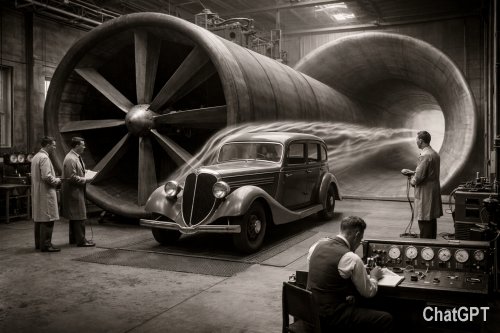
Of the latter, those conducted by the Aerodynamic Research Institute in Göttingen, the German Aviation Research Institute in Adlershof, and the Automotive Research Institute in Stuttgart under W. Kamm are well known. In
addition, there are the Zeppelin factories in Friedrichshafen and the Junkers aircraft factory in Dessau.
Manufacturers who did not have access to this had to find other solutions, e.g., Opel with a racetrack and others with so-called run-out tests. Under certain favorable circumstances, almost anyone could do this with his or
her car. Simple basic principle: The further a vehicle rolls after the engine is switched off, the better.
Of course, the cross-sectional area of the vehicle would have to be known, and in principle, the speedometer would have to be calibrated and the route would have to be completely horizontal. Tire pressure also plays a
role, and of course it mustn't be too stormy, as then trying both directions won't help.
Run-out tests are still carried out today. Certain EU countries have secured the associated benefits by offering roadways with the minimum permissible gradient. Manufacturers also use tricks, such as taping off certain
areas of the bodywork, manipulating the vehicle weight, etc.
|