Exhaust - Diesel engine 1 Exhaust - Diesel engine 1
It could be interesting to find out how long it takes before improvements built into new vehicles have actually displaced one from the old vehicle. The fact is, our cars have become more durable. And if not with us, then in
countries where our cars will continue to be used. This means that they are driven until they finally fall apart.
It is the indirect subsidization of poorer countries that is favored by the sharp fall in used car prices. In rich industrial countries, new vehicles are bought after four to six years and old ones are given away cheaply. The concept
originally comes from the USA, where at times people got used to buy a new car every year.
Used vehicles are usually technically so good that after a second use they are even sent to a third use according to the living standards of the countries. That would be, for example, countries in Africa with correspondingly lax
safety regulations. And there the question is already allowed, how long it will take until the new one has finally displaced the old vehicle.
It is also interesting to see what is more beneficial to the environment, the respective production of a new vehicle with better exhaust gas detoxification or the operation of an old vehicle as long as possible and often referred
to as 'sustainable'. Of course, manufacturers try to make production as environmentally friendly as possible. The recycling rate of 95 percent and more that is being targeted in the near future will also help here.
But you can turn and turn it however you want, the energy is consumed and some resources taken from Mother Nature are also needed. To get to the latter, a multiple of overexploitation is necessary. Just think of the new
production of aluminum, which not only consumes twice as much energy as the recycling, but also leaves behind dangerous products such as red mud.
Precisely such a question may already be raised by further developments in the field of diesel engines. Namely exactly at the point where an improvement in exhaust gases is no longer necessarily associated with a
reduction in consumption. The enormous decrease in permissible nitrogen oxides during the transition from Euro 5 to Euro 6 reveals a certain conflict of objectives between reducing pollutants and fuel consumption.
What kind of engine is that actually? The diesel engine lives from the change in the size of the work area, significantly more than the gasoline engine. Before the invention of the four-stroke engine, it managed as an engine by
Lenoir and Otto (atmospheric gas engine) without a compression stroke, although with very little power, but at least. That would be impossible with a diesel engine. Without the enormous pressure at the time of injection,
there would be no combustion.
Conversely, the diesel engine, assuming a correspondingly high pressure or temperature (up to 900° C), runs with a larger number of fuels over a wide range of mixing ratios. The petrol engine would have stopped operating
long ago. Because it needs a very specific mixing ratio and, for example, a specific knock resistance of the fuel. Rather in the opposite sense, there is the cetane number in the diesel engine, but of secondary importance for
operational safety.
Of course, the geometric compression ratio should not be viewed as solely for the pressure or the temperature in the combustion chamber. It can vary between 6 : 1 for large engines and 24 : 1 for cars. We assume
particularly effective charging for the large engine, for which, of course, the compression must be reduced accordingly due to the stress on the material. The value for the car would be related to a purely naturally aspirated
engine, which hardly exists any more. In the case of charged diesel cars, around 16.5 : 1 is common at the moment, with a slight downward trend.
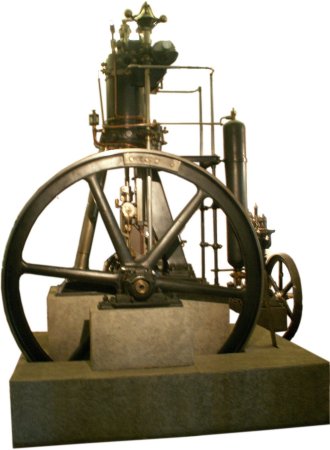
Some of the dreams of the inventor Rudolf Diesel only came true much later. He had in mind an even full utilization during the work cycle, which can only be achieved today through high-pressure injection distributed over a
longer period of time. And with charging, there is also high pressure in as many operating areas as possible. For example, this helps the truck engine in particular to save.
To be economical, the diesel engine is driven with a lean mixture. If lambda 1 corresponds to a ratio of around 15 kg (14.8 kg) air to 1 kg fuel, then the diesel engine is usually operated in the range of 30 : 1 (lambda = 2) to 60
: 1 (lambda = 4). Of course, diesel engines could also soot, especially when accelerating strongly. Then either the total lambda value had slipped below 1 or, much more likely, a partial lambda significantly less than 1 was
created.
So if you should drive behind a vehicle with a diesel engine again, then with a longer observation time you can determine with great precision whether it is a modern diesel engine with largely restrained exhaust emissions or
a diesel engine that is open in this regard. With the latter you will find yourself in the soot cloud when it accelerates vigorously, with the former you remain clean even then. But more on that later.
|