Battery technology 3 Battery technology 3

kfz-tech.de/Pe29
The future has arrived in the field of car repairs. There are already the first recalls relating to the high-voltage battery. Hyundai has set up a center for the complete replacement, e.g. with the Kona, where the car has to be
taken, but at VW the subsequent sealing of the casing was still carried out in the workshop.
Vehicle mechatronics technicians will therefore have to get used to working on high-voltage components. Courses of instruction are necessary for this, because without such a course you are not even allowed to open the
bonnet, if there is one, for good reason.
There's a good reason for that. The technical term for this would be a possibly missing 'equipotential bonding'. A very simple possibility for this error: A high-voltage cable is in contact with the body. However, at the same
time, the cable would have to have a defect, which connects the body to the casings of other HV components.
So don't worry, such a case is probably much rarer than winning the lottery. Nevertheless, measuring the potential between the components is an important part of the preparation. We now switch the vehicle potential-free
and secure this state permanently, e.g. by deposit the key far away from the vehicle.
| The basic prerequisite is electronics training with an examination. |
Since we are now disconnecting anyway, let's also disconnect the negative pole of the battery. This is not only responsible for the maintenance of all 12V components in the vehicle, but even more importantly for monitoring
the high-current circuits. Disconnecting discharges capacitors and opens contactors.
If disconnecting means that the vehicle no longer works, then this state has already been reached. In the case of our Kona, it's under the rear seat. Of course, nothing works without the appropriate instructions or circuit
diagram, which also states that the bracket that is folded up is initially blocked by the yellow lock.
| The removed plug is safest in the pocket of the mechatronics technician. |
The purpose of the 12V fuse, which also accompanies this connector, should be made clear once again. The series connection of this fuse with the plug means that this is switched off first. If there is not enough time, the
fire brigade does not necessarily have to look for a 10mm wrench in order to secure the entire high-voltage circuit.
However, there is an even easier point for the fire brigade to reach, a loop to be cut under the hood at the front. However, you have to realize that although the high-voltage battery is now separated from all systems, it still
represents a risk that should by no means be underestimated. Therefore, thick rubber gloves and perhaps other masquerade are required.
Although direct current is a little less dangerous for humans than alternating current but at 60 V a limit is also reached here, whereby the at least 400 V of a high-voltage car battery also far exceeds the current limit in terms of
current strength, i.e. with the shock on a 230V network are probably not comparable.
So, step 1, disconnecting, and 2, preventing switching on again, are done, now comes step 3, checking the absence of voltage. Whoever intends to take such a measurement has a sufficiently insulated and therefore
suitable voltmeter or can borrow one. Also very important to check the function of the device somewhere before the measurement, because 0 V can mean that there is no voltage, but it can also mean a defect in the device.
Now you are almost in the middle of a possible repair. As with any other repair, it would be good to make sure that you have all the necessary parts for the next steps together, because otherwise it will not be possible to get
the car ready to drive again so quickly.
There are horror stories about, for example, the need to chisel open the glued seams or necessary renewals that you would never have thought of in your dreams. That's why it seems really important to follow the
manufacturer's specifications, which you can often get access to for a limited time. You always endanger others too, even if you only use the car yourself.
| Of course, even after the HV battery or parts of it have been disconnected, there is still a risk. |
Now you can of course ask yourself what the whole procedure is about, if it is not clear anyway whether you can even get parts for a repair. Of course, they may not be necessary when sealing the battery box afterwards, but
VW, for example, says that they would not deliver individual batteries, but at least they would be delivered together as modules.
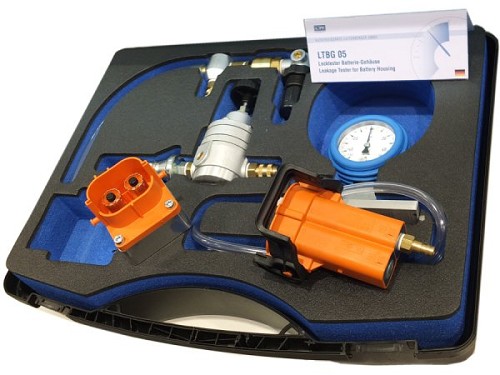
Whether only to certified workshops or to all workshops and whether they can then also be reached by private individuals, we leave open for the time being. If you see which devices are also and especially offered to
independent workshops for preparing work on electric vehicles, you can assume that regular repairs to the high-voltage system are possible.
kfz-tech.de/Pe210
Of course, they only have a chance after eight years instead of four years, because that's how long a guarantee lasts, which a customer naturally insists on against the brand workshop if the worst comes to the worst. This
also means that all mandatory inspections should be carried out as far as possible.
Incidentally, with the Elektro-Kona this is annual, which is a step backwards compared to our Golf. But at least you seem to stick to the price information when buying the car: €100 for the first, €200 for the second and €300
for the third. Then the TÜV is still involved, what due to the lack of an exhaust gas test means only two-thirds of the costs compared to the combustion engine.
| Advertising revenue neither from the picture above nor from the video below. |
kfz-tech.de/Ye210
|