2025 Ferrari Cilindri
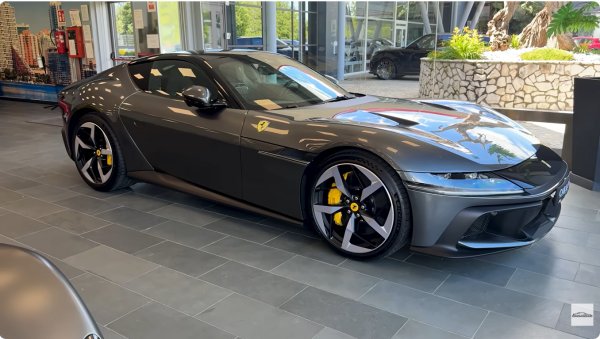
It is available as a Spider and a Coupé, which can have a glass roof or a carbon-fiber roof, either black or with a visible carbon-fiber pattern. A typical feature is the wide strip between the headlights, also
variably orderable.
Together with these, it is somewhat reminiscent of the 1969 GTB/4 model, better known as the Daytona. It always features Matrix LEDs and optional cornering lights. These include the long, yet
unusually simple daytime running lights, which becomes a turn signal when needed.
Toward the side, the slit narrows slightly, but, with the exception of the rear wheel covers, it runs prominently across the entire side, and on the door it is even accentuated by a double corrugation. At the rear
it continues under the fenders and the tailgate.
The former can only be raised by 10° at a time, depending on the speed. The four exhaust tips are chrome-plated, but they are slightly
hidden by the bulky diffuser. It's interesting to see how the different surfaces interact.
What doesn't stand out at all, unlike almost all other rear designs, are the taillights. The turn signals under the wings are also only visible when they are in use. The (electric) opening of the
tailgate is huge, revealing a surprisingly deep luggage compartment.
| Doors with soft-close mechanisms |
Inside, starting behind the steering wheel, there can be up to three displays, measuring 15.6, 10.2, and 8.8 inches, in front of the passenger seat. Unusually enough, the car is started using a button located below the
center of the steering wheel. The two buttons on the left and right for the turn signals remain mechanical.
Which brings us finally to this vehicle’s powertrain, which has become very rare: a naturally aspirated V12 engine positioned almost entirely behind the front axle, with the transmission at the rear. In terms of power output, it
stands out with 94 kW (128 hp) per liter, a figure surpassed worldwide only by the Ferrari 458 Speciale, which delivers 99 kW (135 hp).
80 percent of its maximum torque is already available at 2,500 rpm. The 12 Cilindri engine family traces its origins back to the Ferrari Enzo, which originally had a 6.0-liter displacement and has had a 6.5-liter displacement
for some time now, though, of course, Ferrari has always had a V12.
The increase in power of 22 kW (30 hp) compared to the 812 Superfast is partly due to a further increase in engine speed, which now reaches up to 9,500 rpm. The connecting rods are made of titanium, and for the pistons
a newly developed aluminum alloy is used.
Apparently, the crankshaft is balanced differently, which, by the way, sounds easier than it actually is when you consider the pistons, piston pins, and connecting rods that are always attached. In addition, because there is
less friction with the different coating on the rocker arms, the rollers in the valve train are no longer needed.
The intake ports are likely the same for all cylinders, but they are also adjustable, and each one is equipped with funnels to ensure the most laminar flow possible. They even want to have succeeded in
using the airflow toward the car to achieve certain charging effects.
As a result, the vehicle is likely to reach its maximum power only at high speeds. On top of that, they also say to have designed the torque curve differently depending on lower or higher gears, additionally through variable
valve control.