Golf 1 (1) Golf 1 (1)
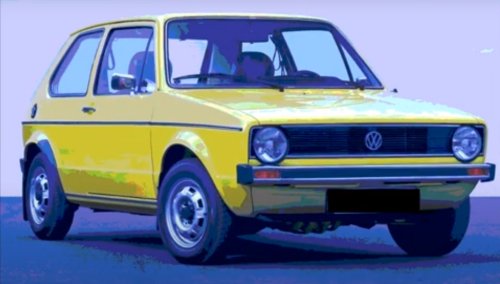
kfz-tech.de/YVW245
Golf 1 1.092/1.471 cm3 (72,0/76,5 mm * 69,5/80,0 mm), 8,0 : 1, OHC, toothed belt, 80/112 Nm 3000 rpm, 37/51 kW (50/70 hp) 6000/5800/ rpm, OHC, rocker arms/bucket tappets, single
carburetor, four-speed, front-wheel drive, McPherson, torsion beam, discs, drums, length 3.71/3.82 m, 2.4/1.61/1.41 m, 145/155 R 13 (4.5/5''), 2/4 door model, from 750 kg, 40 liters, 140/157 km/h, from 7,995 DM
Until this car was presented, golf was a lawn sport, just like polo, only much more civilized. But VW's bosses had obviously run out of names in the previous context; there aren't that many winds like the 'Passat' or 'Scirocco'.
The car didn't actually look that revolutionary, but its birth came at a far from harmonious time. The company was on the edge of the abyss and would probably no longer exist today, at least not in this form, if the Golf had
ultimately not been successful.
This increased the pressure enormously, but also strengthened the innovative forces. It was VW's first passenger car apart from perhaps the Type 3, which looked like a 'normal' car. Until then, anything but sensible cars
had been developed as a much too late replacement for the Beetle.
It should still remain with the rear engine, or the engine should be stowed lying under the rear seat (Project EA 266). Porsche is known for showing relatively little consideration for passengers and their transported goods.
They sell engine compartments rather than passenger compartments on wheels.
Only when this million-dollar grave was replaced at the last minute by a courageous or perhaps desperate CEO Rudolf Leiding with existing Audi technology was the way clear for the Golf. In principle it was the first front-
wheel drive car from VW (except NSU), although the Scirocco with the same underbody appeared just before it.
The VW Passat as an Audi 80 with a large tailgate didn't count. The Golf alone allowed itself technical and, above all, design special features. By the way, like the large tailgate of the Passat, the design is supposed to come
from Giugiaro. Compare his design below with the original at the top.
Giorgetto Giugiaro states that at the beginning of 1970 he received a development order for his company Italdesign Giugiaro, which was founded in 1968, from Kurt Lotz, who was still acting chairman of the board at the time.
There is no mention of several existing drafts.
He was not only supposed to develop a successor for the Beetle, but also a model family from it. The result is the model shown below. He then developed a new hatchback Passat, but due to the change from Lotz to Rudolf
Leiding, this EA 272 project was stopped.
The Passat came in 1973 as the Audi 80 with a sloping tailgate. But of his proposal for the new Golf, Giugiaro claims that his concept was already accepted in mid-1970. However, he admits that a lot at his concept had
been changed by the time the series started, but the aesthetics would have been preserved.
For cost reasons, however, one switched from rectangular to round headlights. The body was also extended to the front by 10 cm. Ernst Fiala came to VW in 1970 and was a board member for research and development
from 1972. He reports a little differently about the development of the VW Golf.
The origin of the name 'Golf' is also controversial. Some say that was the name of someone on the board's favorite horse, others see its origins in the Gulf Stream, more likely because the names of the other models are
'Passat' and 'Scirocco'. Only the 'Polo' doesn't really fit, but the didn't come until 1975.
Fiala did not have a good opinion of VW's developments to date. The draft EA 266 also found no mercy and neither did Giugiaro's EA 337. He found the shapes to be too angular and wanted more curves. He also noted
serious problems with the water cooler and the transition from the transverse engine to the exhaust system.
Under his direction, the tailgate had more inward curvature than the EA 266 and a trailing edge that also improved the aerodynamics. He says he got rid of the drum brake at the front, but he probably wasn't able to do this
initially for the cheapest versions. Heating and ventilation were also redesigned.
He also didn't like the tailgate styled by Giugiaro for the Passat and changed it six months before series production began. Overall, however, he described the birth of the Golf 1 as 'quite painful'. Sales were by no means
outstanding at the beginning and the workmanship was rather poor, especially in the area of rust prevention.
kfz-tech.de/YVW210
|