Kupplungsglocke
kfz-tech.de/PKp7
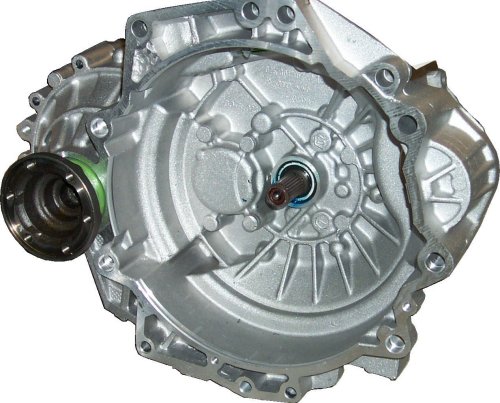
A nice picture of the housing of a transmission with a view into the so-called clutch bell. The clutch plate for the longer right drive shaft indicates that this is a transverse installation. A piece of the axle drive protrudes behind
the plate.
The release bearing has already been removed and the bearing of the output shaft is clearly visible, all cast into the aluminum housing. The same applies to the cover for the starter motor, which in this case is located next
to the transmission.
The numerous reinforcements inside the clutch bell and even more so around the outside are also astonishing. When really only the clutch needs to be covered from the outside world. It doesn't even have to be airtight,
because it's just a space filled with air.
Woe, some oil drips out the bottom. Then you automatically suspect one of the two oil seals towards the engine or transmission, the latter of which is even shown here. Then inevitably the engine or transmission has to be
removed.
Here case of a transverse engine, sometimes both the transmission and the engine are removed instead of just the transmission, so that the engine does not have to be laboriously supported. It is usually impossible to
remove only the engine. And once both are outside, these openings all around turn out to be opportunities for connections between the two.
The engine and transmission are separated here, and this is where they derive their stability as a block. This is also the only place where you can damage both the engine and the transmission at the same time. All you
need to do is forget to even come close to tightening the screws.
This is precisely when the transmission shaft rubs against the crankshaft and causes additional damage. However, this shaft is immune to this because it is mounted so stably in the gearbox that it does not need the roller
bearing in the crankshaft.
In the past, the clutch bell could be opened from below, i.e., it was fitted with a sheet metal cap. Then you could also check the condition of the clutch disc and the gear drive to the starter, which wasn't bad for a thorough
inspection.
Opel vehicles were even more cleverly designed. It was a long time ago, and of course it was with longitudinal drive. It was possible to unscrew the cardan shaft and a locking device with a cover, and then pull out the
main shaft of the transmission at least far enough to allow the clutch to be replaced without removing the transmission.
The strategy for removing the transmission is also different for longitudinal engines. As mentioned, loosen the cardan shaft at the front end, as well as all connections to the interior, e.g., the gear lever, and then, after
loosening the screws toward the engine, remove the transmission.
With the VW Beetle, it was exactly the opposite. The engine was loosened at four bolts and all connections, and in the best case scenario, it was out in five to ten minutes. In the case of the large VW and, of course,
a Porsche 911, both had to be removed again.
The reversal of the engine and transmission in the Boxster further reduced accessibility to the engine. Here, both were even removed for a major inspection, although it was also possible to remove only the transmission
from the rear in order to access the clutch.
|