Two-stroke Two-stroke
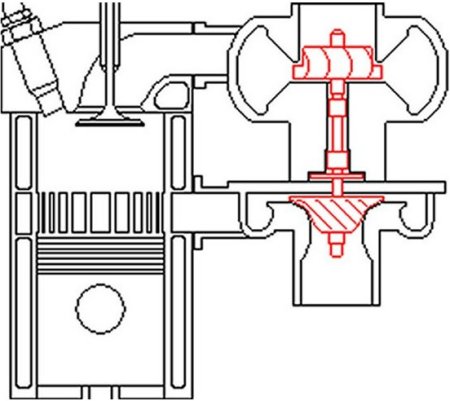
You may be wondering what the topic of 'two-stroke engines' is doing in a book about diesel engines. The idea behind this is that the two-stroke engine ended up in the graveyard of technical history with the GDR Trabant
at the latest. However, we must ask for a short break here. Let us compare the two principles and see how well they fit together.
The two-stroke principle means that the four strokes required here too are combined in such a way that a complete working cycle is completed after just one revolution of the crankshaft. So don't be confused by the valve at
the top (+controlled by a camshaft). Valves are also possible in a two-stroke engine, in this case outlet valves.
Supercharging is also possible and in this case absolutely necessary, of course a turbocharger, which is particularly well suited to the diesel engine. And now comes the real reason for the successful cooperation of the
two-stroke engine with the diesel principle: basically only pure air is sucked in, or in this case blown in at high pressure. Above you can see how this gets directly from the compressor wheel into the combustion chamber.
Since the slots are arranged all around and the outlet valves are open at the top, the exhaust gas from the previous working cycle is reliably and completely blown out.
All problems with scavenging, as we know them from old two-stroke engines, are solved here, because you can scavenge with incredible amounts of air. The smell of burnt engine oil and the filling of mixture are also a
thing of the past. There is a completely normal oil sump here, wet or dry, just as the application of the diesel engine requires. Actually, it is a completely normal engine, which, for example, would be almost
indistinguishable from a four-stroke engine from the outside.
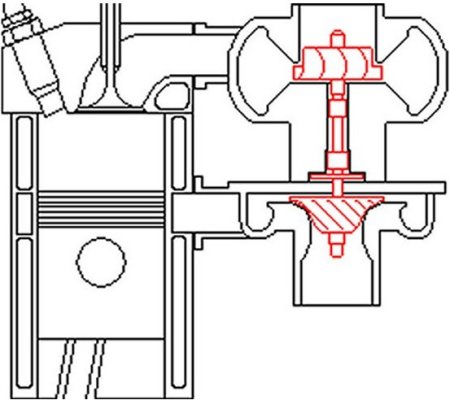
Here you can see the start of the compression stroke. The slots are closed and so are the outlet valves. A certain pressure is already present due to the injection, so that the higher compression required for the diesel
engine is achieved on the rest of the piston's travel. It is even possible to not have the outlet valves close exactly with the slots in order to achieve certain effects.
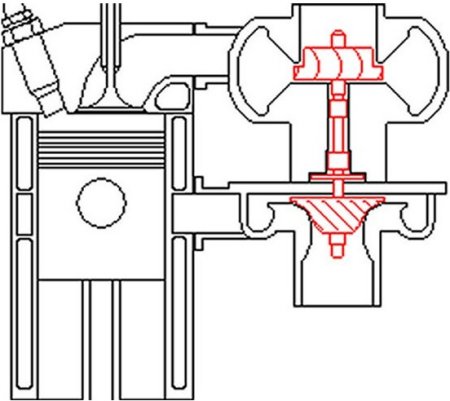
If the piston is at TDC, we have reached the beginning of the power stroke, just like with a four-stroke engine. You can pre-inject or post-inject, multiple injection is possible. Please remember that the stroke of diesel
engines is often still a little larger than that of petrol engines. You can therefore make full use of the time until the slot opens. Even variable control of the exhaust camshaft would be conceivable, and with it, of course, the
amount of exhaust gas to the turbine wheel of the turbocharger.
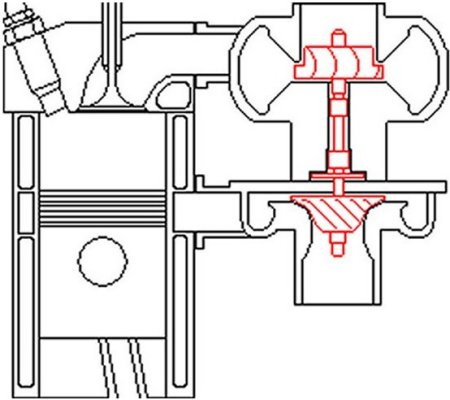
But then there is the huge advantage. Even if it may not produce twice the power with the same displacement, it is certainly much more than with a four-stroke engine. Downsizing would be even more effective, especially
reducing the displacement to two cylinders. Because with a two-stroke in-line engine, both pistons would not perform the same movement, but rather opposite to each other, which would greatly benefit the mass balance.
And why haven't such engines been around for a long time? Perhaps because it requires more investment than, for example, downsizing from four to three cylinders. The idea of downsizing is not that old and we are only
just beginning to feel the enormous potential of turbocharging in small engines. It was obviously necessary to get used to the associated burdens. The step from three to two cylinders is also a little further away for diesel
engines than for petrol engines.
| For some new developments in the combustion engine it may already be too late. |
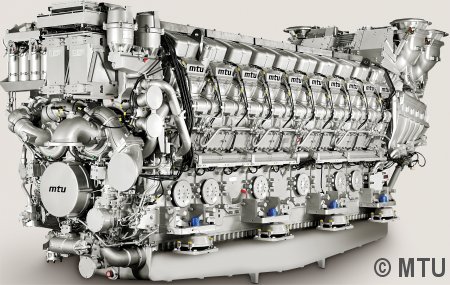
Above you can see what is probably the largest four-stroke engine, in this case from MTU, in the marine engine sector. It has a displacement of around 350 liters distributed over twenty cylinders. In the most powerful
version it produces 9100 kW at 1150 rpm. It is not uncommon for three of them to be connected together on a fast (ferry) ship, for example. If more power is required, up to around 73500 kW (100,000 HP), for example on a
large container ship, so-called slow-running engines are installed, which produce this power at around 100 rpm.
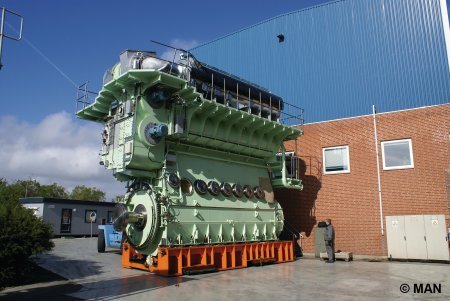
That is so much torque that no transmission is installed between the engine and the propeller. To brake or reverse, you stop the engine and start it again in the opposite direction of rotation. And it is precisely here, where
the use of little cargo space is important, that the two-stroke diesel engine has been used for many years.
kfz-tech.de/PDM39
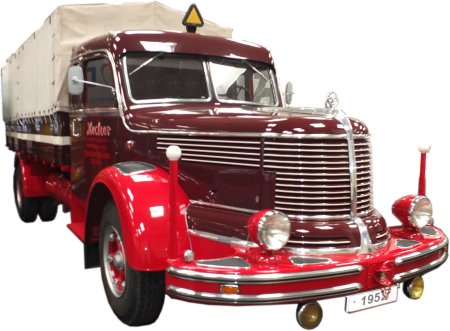
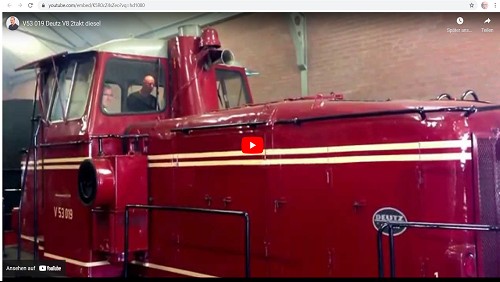
In the 1950s, there were two-stroke diesel engines that could more than keep up with four-stroke engines in terms of performance, but not in terms of durability. Their torque was so great that a Krupp truck sunk with its
rear wheels could potentially break its own axle drive when trying to move off.
kfz-tech.de/YDM14
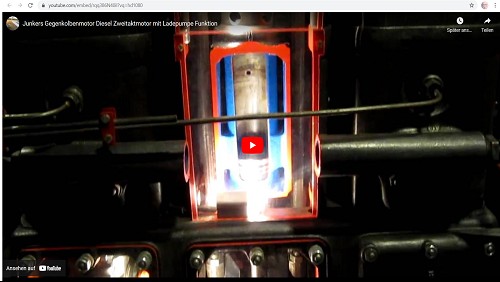
kfz-tech.de/YDM15
|