AI errors AI errors
What if the AI makes mistakes? I tested this (unintentionally) while working on a chapter about the Porsche 911. It's a nice example of how ChatGPT can make mistakes, and yet
you can still enjoy the conversation.
It all began with the Porsche transmission, which was likely adopted out of respect for the brand but had become slightly outdated due to a lack of lock-up synchronization. At least we were still in agreement on that. With
the Solex triple carburetors, the AI started to wobble a bit. Which ones do I mean?
It had explained the two triple carburetors very well up to that point, so it's asking me for no reason. And then it actually begins to correct itself in a curious way: a distorted image consisting of impossible arrangements of
carburetors corresponding to the supposedly relevant cylinders.
You correct it, and it goes back to its original explanation. After all, it couldn't possibly be the way it just explained it. It even answers the actual question about the number of swim compartments correctly for once, and, as
always, in an incredibly verbose manner.
Then there is the question of whether the dry-sump lubrication system on the 901/911 might be thermostatically controlled. The AI confuses this with a thermostat for the oil cooling system. Again, I corrected it
followed by its statement that it understood my question perfectly.
And yet another "yes," but this time with a very vague reference to later Porsche models. Then, of all things, it temporarily shifts the thermostatic control to the race engines, which have no problem with cold oil because they
don't get onto the racetrack until the temperature reaches 80°C.
So we're in agreement again about the space-saving layout of the front suspension. But now ChatGPT is insisting that Porsche did not invent the torsion bar suspension, but 'only' the system for this suspension
with support levers.
When I asked about another vehicle from before 1934 with torsion bar suspension, the Citroën Traction Avant suddenly came up, though it’s not really comparable because its torsion bars are mounted on the
rigid rear axle. In addition, development likely began after the Beetle.
This is followed by a lengthy story about the philosophy of Porsche and its designer, Karl Rabe. It's all more or less correct, but there are sentences like those about the torsion bar suspension that I can't quite agree with.
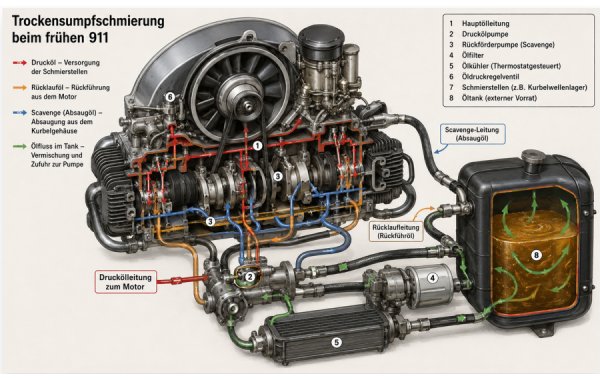
When it then showed me an image (above) that was supposed to depict one of the components mentioned, the AI chose, of all things, the most complicated one: dry-sump lubrication. Take a moment to look at it carefully
and ask yourself how it might have come about.
If you just look at the engine, it's a completely twisted conglomerate that's oriented upward toward the air cooling system. This misprint provides a good overview of how ChatGPT
assembles images that it doesn't have ready-made from any source.
That said, provided you have enough knowledge, it's fun to discuss technical problems with an AI. You definitely learn new things and get ideas that make you think. But under no circumstances
should you always take what ChatGPT says at face value.
| Why does AI sometimes tackle really complex secondary aspects and then make mistakes? |
|