Exhaust gas turbocharger 1

It's still true, especially with gasoline engines, almost a third of the energy taken up with the fuel that is wasted through the exhaust. And it's clear that there is also thermal energy involved. But a good part of the pressure that
escapes into the atmosphere can be used by passing it over a turbine wheel.
But now one has to adjust something. The pressure that a turbine receives is by no means to no purpose. You shouldn't forget the retroaction of a turbine. After all, it creates a jam in the exhaust pipe and this leads to an
increase in pressure. This means that the engine has to do extra work to get rid of its exhaust gases.
The turbocharger was first used in large to giant diesel engines and is still used today there. That are, for example, large ships for up to 18,000 containers with two-stroke engines, always achieving the same conceivable low
revolution speeds. Nevertheless, the power or the torque must be very high because the space for the drive motor is limited for economic reasons. Both suits this type of turbocharger. It enables high performances with
smaller engines.
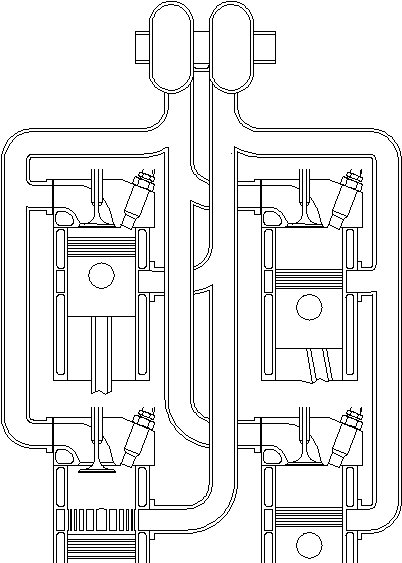
The working principle should be clarified by the picture above. It shows the piston in four different positions within the two-stroke principle, of course only during a single rotation. At the top left, ignition is in progress, with
which the work cycle begins. To the right of this, the end of this cycle is almost reached, because as the picture below left shows, the outlet ports are now opened by the piston.
There is no pre-compression in the crankcase with a normally possible oil sump together with an overflow duct. This is done by the turbocharger. It blows at least as much air through the combustion chamber through the
open intake ducts that all exhaust gases disappear. If the outlet ports are closed first, additional pressure is created for the subsequent compression by the piston.
In motor vehicle engines, the turbocharger naturally has more difficulties. To address one extreme directly, let's start with the motorcycle engine. This is an excellent way to explain in more detail the difficulties of the
turbocharger on the vehicle engine. A motorcycle engine seems really unsuitable because it runs through an enormous speed range and also has to react very quickly to acceleration.
In the automotive sector, however, one has to be very careful with claims that this or that never existed. Perhaps one could say that a motorcycle with a diesel engine was never built, although that is not true either. But there
have been many supercharged motorcycles, in principle from all major manufacturers: e.g. Honda, Yamaha, Suzuki, Kawasaki and Ducati.

Here is a picture of a Kawasaki KZ 1000 Turbo Mystery Ship from 1980. The exhaust pipes are grouped together and go up to the turbocharger near the intake ports. The compressor in the motorcycle became much more
famous by Ernst Henne, who set a total of 77 speed world records between 1929 and 1937, the last with 279 km/h, e.g. on the BMW WR 750 shown below with 75 kW (102 hp), here without fairing.
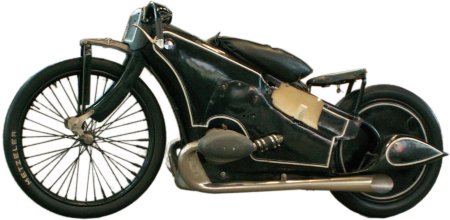
Now you might think that in the early days motorcycle engines were made more powerful with compressors and later only with exhaust gas turbochargers. Wrong, because there are state-of-the-art motorcycles, e.g. the
Ducati Vyrus 987 C3 4V Supercharged whose charging works via a compressor. So if anything, that seems like a better choice.
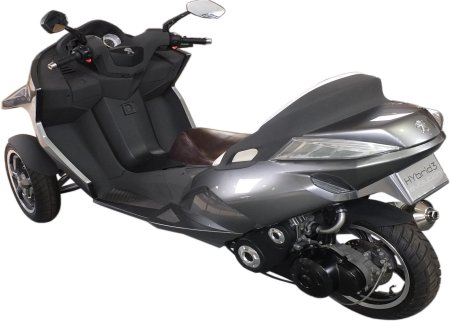
Finally, a technical highlight from Peugeot. In this three-wheeled Hybrid 3 Scooper concept from 2008, the 125 cm3 petrol engine on the rear axle is charged by a compressor and combined with two electric
motors, good for 8 additional horsepower. 150 km/h top speed and only 48 g/km CO2 should be the result.
|