Aerodynamics 2 Aerodynamics 2
Of course, this cannot be done without mathematics. Here is an introductory course that almost anyone who comments on cars can master. But be careful, at this point it is essential to distinguish between two
terms.
It may not be a bad idea to compare the cross-section of a vehicle at its widest point with its cubic capacity. In the past, people used to say that the only thing better than displacement is more displacement. But at that time,
turbocharging was not yet playing such a major role in production cars.
Therefore, we can say better than a smaller cross-sectional area is still a smaller one. Is there nothing that can be done about it? Yes, because there is still the so-called cW value. This determines
how much of the cross-sectional area affects air resistance.
It would be comparable to the compression ratio in a combustion engine. This can more than compensate for certain performance weaknesses with low displacement. If it is too small, even an engine with a large
displacement will be relatively weak in terms of performance. There is also the impact on economic efficiency.
| Did you know that until recently, the geometric compression ratio in Formula 1 was 18:1? |
The same applies to the cW value. A spacious body can still glide elegantly through the air thanks to its shape. Both values are even linked, because a comparatively large, or rather long, body offers more
possibilities for optimal design.
But be careful: the two values, cross-sectional area and cW value, are in principle independent of each other. It is therefore incorrect to say that a car body has an unfavorable c_W value simply because it has
a large cross-sectional area.
And how do you determine the two values? Just as we provided the sphere and the wing of the aircraft with parallel airflow at the beginning, we now illuminate a car from the front with parallel light, i.e., not
point-shaped light.
This creates a shadow on a vertical wall behind it, which represents the largest cross-sectional area of the car body. This can therefore be gripped. The cW value is much more difficult to determine.
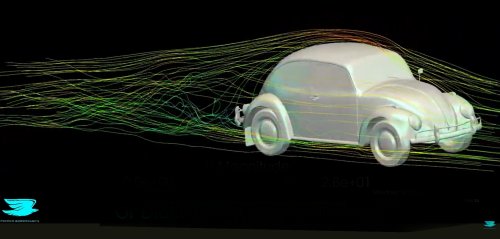
When Professor Porsche developed the Beetle, it had to be driven at speed under a bridge to test its aerodynamics and then photographed from above with a high-speed camera (video above).
Small woolen threads were attached all over its bodywork, which then indicated any problems with airflow. A cW value cannot be determined in this way. Even the so often shown visualizations using smoke
cannot do that.
This involves placing the car in a wind tunnel and securing its wheels to a movable plate. A very powerful blower pumps air from the front, whereby any boundaries of the wind tunnel must be far enough away from the
vehicle.
The most important factor is the speed of the air flow, which is even taking in account in the calculation of the cW value to the square. Their density also plays a role, as can be seen from the
formulas below.
A ·  · v² · cW · v² · cW
FL
= 
2 |
FL · 2
cW = 
 · v² · A · v² · A |
| Air resistance | FL | N |
| Cross-sectional area | A | m2 |
| Air velocity | AV | m/s oder km/h |
| drag coefficient number | cW | |
| Density (air) | | kg/m3 |
|