A B C
D E F G H I J
K L M N O P Q
R S T U V W X
Y Z
 V8-engine V8-engine
by Christian Thiemt
© C.Thiemt
Cylinder block
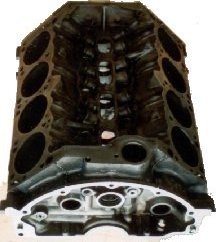
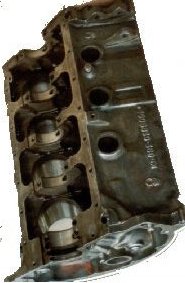
The american V8 engine still features cast iron blocks. Sometimes aluminum is used for high performance.
The angle of the cylinders is always 90°.
In the US two block sizes are distinguished, small blocks and big blocks.
The sizes differ from manufacturer to manufacturer and are not influencing the cubic capacity.
  © C.Thiemt © C.Thiemt
Rotating assembly
The heart of every engine is its crank. It transmits torque by rotation to the drivetrain. The crank defines the displacement of an engine by providing the stroke. This is double the distance between the middle of the main journal and the
middle of the rod journal.
Like cylinder blocks also crankshaft are cast, in some cases even forged. For high performance racing purposes, billet cranks are used. They are machined from one metal billet for extra strength. This
procedure is not only extravagant but expensive.
 © C.Thiemt © C.Thiemt
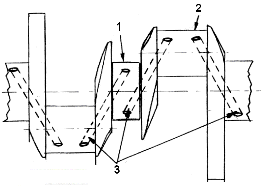
A V8 crank features 5 main journals and 4 double rod journals. Joining rods work in opposite cylinders. For better lubrication oil passages are drilled in the crank from the center of the main to the center of the rod bearing journal
(drawing).
Connecting rod
 © C.Thiemt © C.Thiemt
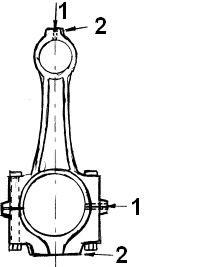
Connecting rods are made from forgings. To avoid stress risers the shafts used to be polished. There are two different styles of rods, on the one hand rods with pressed piston pins and on the other hand full floatings. Pressed pins are
pressed under heat inside the rod, full floaters are locked by spirallocks or tru-arcs.
Piston
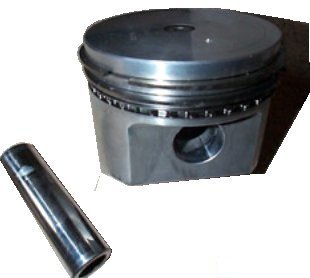 Piston 7,2l big block © C.Thiemt Piston 7,2l big block © C.Thiemt
The piston is cast from an aluminum alloy and drilled later to a perfect fit. Aluminum is chosen to reduce weight but guarantees reliability. Friction in the cylinders is reduced and the crank doesn`t get that high loads. The weight of a
factory piston is near 590 grams. (Numbers of a 5,9l small block).
The piston defines the compression ratio of an engine by the distance resulting between combustion chamber and the deck height above the piston.
Cylinder head
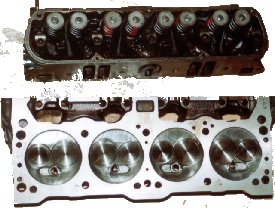
Cast heads with polished chambers and ported and polished ports
© C.Thiemt
American V8 cylinder heads used to be made from cast iron. Aluminum heads are available for performance applications. Traditional V8s breath through 2 valves/chamber, 8 valves/head. Intake and exhaust valves are located on
opposite sides. Valvetrain
 © C.Thiemt © C.Thiemt
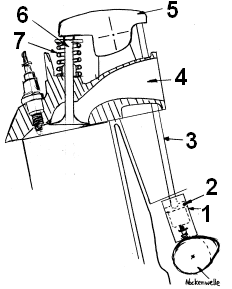
The valvetrain consists of many parts, like camshaft, lifters, pushrods and rockerarms. Last but not least the valve with spring helt by retainers and keepers. Camshaft
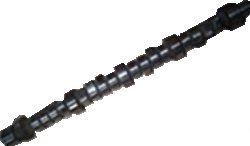 Chrysler Camshaft (242°/0,412" lift) © C.Thiemt Chrysler Camshaft (242°/0,412" lift) © C.Thiemt
The cam considers timing of the valves. This happens with 16 lobes pushing lifters and rods. Like the crank it has 5 journals and is connected to the crank via a timing chain.
The cam is responsible for driving the oilpump and
distributor. Tappeds and push rods
 © C.Thiemt © C.Thiemt
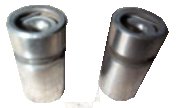
There are 3 sorts of tappeds: mechanical, hydraulic and roller tappeds. Especially with roller tappeds camshafts with very steep cams are possible. The engine gets more power because of the long opening of the valve, is more silent
and has less drain. The push rods are made from chrome-molybdenum steel and connect tappeds and rocker arms. Rocker arms
They are available in different sorts and qualities. Widly distributed are roller rocker arms for more power and less drain for the valve. Material: steel or aluminum. Valves
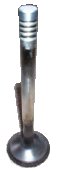 Exhaust valve of a 5.9l small block © C.Thiemt Exhaust valve of a 5.9l small block © C.Thiemt
The valves are mainly made from stainless steel. A V8 has 16 of them. Intake valves are clearly bigger than exhaust valves.
|